Posts

3 days left to file your Self Assessment tax return

3 Days to the Self Assessment Tax Return Deadline!

3 days to the self-assessment tax return deadline!

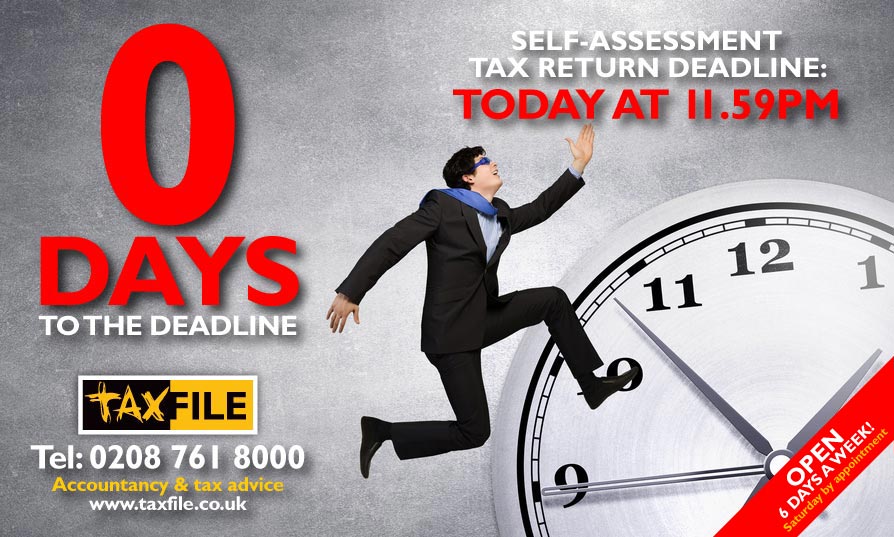
[As at 28 January 2026]: There are only 3 days left to file your Self Assessment tax return and pay any tax due by HMRC’s 31 January deadline. If you miss that deadline, you risk a £100 HMRC fine right away plus other significant penalties thereafter. Time is running out, so contact Taxfile for help with your tax return as soon as possible please. Book an appointment* with one of our helpful tax advisors and accountancy experts TODAY and we’ll make filling in and filing your tax return easy!

We’ll make filling in and filing your tax return a breeze!

We’re open 7 DAYS A WEEK this week (Saturday 31 January by appointment*). Don’t leave it to the last minute, though, as there is always a bottleneck — come in as soon as you can, please, for professional help with filing of your tax return. We’ll require your records, figures and receipts for the financial year 6 April 2024 to 5 April 2025. Plus any previous years not yet submitted, if applicable.

* As well as a face-to-face meeting, we can do a ‘virtual’ meeting with you, for example, on a telephone call, using Zoom video, Microsoft Teams, FaceTime, WhatsApp, Google Hangouts — or whatever suits you best.

It doesn’t matter if you have zero tax to pay – you still need to submit your tax return if you’re self-employed or fall into a number of other categories.

* Please note: in busy times like January, a deposit may be required before appointments commence.

4 days left to file your Self Assessment tax return

4 Days to the Self Assessment Tax Return Deadline!

4 days to the self-assessment tax return deadline!

[As at 27 January 2026]: There are only 4 days left to file your Self Assessment tax return and pay any tax due by HMRC’s 31 January deadline. If you miss that deadline, you risk a £100 HMRC fine right away plus other significant penalties thereafter. Time is running out, so contact Taxfile for help with your tax return as soon as possible please. Book an appointment* with one of our helpful tax advisors and accountancy experts TODAY and we’ll make filling in and filing your tax return easy!

We’ll make filling in and filing your tax return a breeze!

We’re open 7 DAYS A WEEK this week (Saturday 31 January by appointment*). Don’t leave it to the last minute, though, as there is always a bottleneck — come in as soon as you can, please, for professional help with filing of your tax return. We’ll require your records, figures and receipts for the financial year 6 April 2024 to 5 April 2025. Plus any previous years not yet submitted, if applicable.

* As well as a face-to-face meeting, we can do a ‘virtual’ meeting with you, for example, on a telephone call, using Zoom video, Microsoft Teams, FaceTime, WhatsApp, Google Hangouts — or whatever suits you best.

It doesn’t matter if you have zero tax to pay – you still need to submit your tax return if you’re self-employed or fall into a number of other categories.

* Please note: in busy times like January, a deposit may be required before appointments commence.

5 days left to file your Self Assessment tax return

5 Days to the Self Assessment Tax Return Deadline!

5 days to the self-assessment tax return deadline!

[As at 26 January 2026]: There are only 5 days left to file your Self Assessment tax return and pay any tax due by HMRC’s 31 January deadline. If you miss that deadline, you risk a £100 HMRC fine right away plus other significant penalties thereafter. Time is running out, so contact Taxfile for help with your tax return as soon as possible please. Book an appointment* with one of our helpful tax advisors and accountancy experts TODAY and we’ll make filling in and filing your tax return easy!

We’ll make filling in and filing your tax return a breeze!

We’re open 7 DAYS A WEEK this week (Saturday 31 January by appointment*). Don’t leave it to the last minute, though, as there is always a bottleneck — come in as soon as you can, please, for professional help with filing of your tax return. We’ll require your records, figures and receipts for the financial year 6 April 2024 to 5 April 2025. Plus any previous years not yet submitted, if applicable.

* As well as a face-to-face meeting, we can do a ‘virtual’ meeting with you, for example, on a telephone call, using Zoom video, Microsoft Teams, FaceTime, WhatsApp, Google Hangouts — or whatever suits you best.

It doesn’t matter if you have zero tax to pay – you still need to submit your tax return if you’re self-employed or fall into a number of other categories.

* Please note: in busy times like January, a deposit may be required before appointments commence.

6 days left to submit your Self-Assessment tax return!

6 Days to the Self Assessment Tax Return Deadline!

6 days to the self-assessment tax return deadline.

[As at 25 January 2026]: There are only 6 days left to file your Self Assessment tax return and pay any tax due by HMRC’s 31 January deadline. If you miss that deadline, you risk a £100 HMRC fine right away plus other significant penalties thereafter. Time is running out, so contact Taxfile for help with your tax return as soon as possible please. Book an appointment* with one of our helpful tax advisors and accountancy experts TODAY and we’ll make filling in and filing your tax return easy!

We’ll make filling in and filing your tax return a breeze!

We’re open 7 DAYS A WEEK this week (Sunday 25 January 10 am-5 pm by appointment*). Don’t leave it to the last minute, though, as there is always a bottleneck — come in as soon as you can, please, for professional help with filing of your tax return. We’ll require your records, figures and receipts for the financial year 6 April 2024 to 5 April 2025. Plus any previous years not yet submitted, if applicable.

* As well as a face-to-face meeting, we can do a ‘virtual’ meeting with you, for example, on a telephone call, using Zoom video, Microsoft Teams, FaceTime, WhatsApp, Google Hangouts — or whatever suits you best.

It doesn’t matter if you have zero tax to pay – you still need to submit your tax return if you’re self-employed or fall into a number of other categories.

* Please note: in busy times like January, a deposit may be required before appointments commence.

1 week to the self-assessment tax return deadline!

1 Week to the Self Assessment Tax Return Deadline!

1 week to the self assessment tax return deadline!

[As at 24 January 2026]: There is only 1 week left to file your Self Assessment tax return and pay any tax due by HMRC’s 31 January deadline. If you miss that deadline, you risk a £100 HMRC fine right away plus other significant penalties thereafter. Time is running out, so contact Taxfile for help with your tax return as soon as possible please. Book an appointment* with one of our helpful tax advisors and accountancy experts TODAY and we’ll make filling in and filing your tax return easy!

Read more

Information You Need to Supply for Professional Help with Your Tax Return

Information You Need to Supply for Professional Help with Your Tax Return

Information You Need to Supply for Professional Help with Your Tax Return

[Updated November 2025]: If you’re self-employed in the UK and earn more than £1,000 after allowable deductions, you need to file a self-assessment tax return each year. It’s not only the self-employed, though. If you are on a higher income* or receive untaxed income from things like property rental, tips, commission, savings, investments, dividends, or foreign income, you also have to submit a return. Partners in business partnerships and those who made a capital gain resulting in Capital Gains Tax (CGT) also need to submit a return. You can check here if you’re not sure.

If you do have to fill in a self-assessment tax return, getting all the tax return fields filled in properly and the figures right can sometimes be difficult. That’s where professional help from companies like Taxfile is worth its weight in gold. But what information will your accountant or tax advisor need from you? In today’s guide, we’ll explain exactly what you’ll need to supply.

* (Those earning more than £100,000 for tax years up to and including 2022-23, or over £150,000 for the tax year 2023-24. Higher earners earning only through PAYE for tax years thereafter only need to submit a tax return if their tax was not collected correctly at source). You can check here if you’re not sure.

What Information Do You Need to Supply for Professional Help with Your Tax Return?

If you’re getting help filling in and submitting your tax return through an accountant or tax advisor like Taxfile, a list of what they will need from you follows below. You’ll need to supply information for the right financial tax year, of course, unless you have a different accounting period.

For the purpose of this post today, let’s assume information will be required for the tax year starting on 6 April 2024 and ending on 5 April 2025.

Here’s what will be needed:

Income-related information if applicable:

  • Copies of all employment income documents (P60s, P45s, and P11ds), as well as any unreimbursed employment expenses.
  • Copies of all pension income documents (P60s, state pension notices, etc.).
  • Details of bank and building society interest.
  • Details of all investment income (interest, dividends, etc.), as well as details of any investments that may qualify for relief, such as the Enterprise Investment Scheme.
  • Details of any self-employed income and expenses (schedules and paperwork).
  • Details of any rental income and expenses (schedules and paperwork).
  • Details of any assets that were sold (or gifted) and may be subject to Capital Gains Tax (CGT).
  • Details of any other income received, including foreign income.

Potential tax relief information:

  • Details of any personal pension contributions made from taxed income.
  • Details of any gifts to charity using Gift Aid.

You’ll also need to confirm if there is any other information that may be relevant to the completion of your tax return.

Personal Information:

If you’re a new client or an existing client who hasn’t supplied them already, you’ll also need to provide the following:

  • A copy of your passport or driver’s licence. This is to comply with ‘Know Your Customer’ (KYC) and ‘Anti-Money Laundering’ (AML) regulations.
  • Confirmation of any changes to your personal details, such as a change of address.
  • If you or your partner receive Child Benefit, you’ll need to provide details.
  • If you have a student loan, you’ll need to provide details of the amount you paid during the year and the remaining balance as at April 5, 2025.

Once your accountant or tax advisor receives all of your information, they will be in a position to prepare your tax return. Once approved by you, they will be able to submit it to HMRC on your behalf.

Do You Need Help With Your Tax Return?

Taxfile would be delighted to help you with your self-assessment tax return — or any other type of tax return. We prepare and submit hundreds of tax returns every year for our clients as well as offering all the usual accountancy-related services like bookkeeping, VAT returns, end-of-year accounts for limited companies, arranging tax rebates for CIS sub-contractors and others, accounting for capital gains tax (CGT), payroll, auto-enrolment for workplace pensions and much moreIf it involves tax or accounting, we can help!

For help with any tax or accounting matter, call Taxfile on 020 8761 8000 or book your free 20-minute, no-obligation consultation here. Alternatively, send us a message and we’ll come right back to you. We’re tax advisors and accountants in Tulse Hill near Dulwich (SE21) in the South East. We are open 6 days a week during December and January!

020 8761 8000 Book Appointment Contact Us

We Open 6 Days a Week This Week!*

* Mon/Tues: 9 am-6 pm, Weds/Thurs: 9 am-5 pm, Fri: 9 am-3 pm as usual. Saturday 31 January 2026: 9 am-6 pm by appointment only.


Stay Ahead of HMRC Compliance Checks for CIS Contractors

Stay Ahead of HMRC Compliance Checks for CIS Contractors

Stay Ahead of HMRC Compliance Checks for CIS Contractors

By Ali at Taxfile.

As the new tax year approaches, CIS contractors must prepare for the upcoming 2024/25 tax return season.  Last year we witnessed a significant increase in HMRC compliance checks delaying refunds, with many contractors being asked to provide detailed CIS pay/deduction slips and bank account transactions to verify their income.

At Taxfile, we are here to help you navigate these challenges and ensure your tax affairs are in order while offering you peace of mind with our unique HMRC investigation cover.

Why Are HMRC Compliance Checks on the Rise?

HMRC has ramped up its efforts to ensure compliance among CIS contractors, particularly focusing on verifying income and deductions. Last year, many contractors were caught off-guard when asked to provide:

  • CIS pay/deduction slips to confirm tax deductions at source.
  • Bank account transactions to prove income received from contractors.

Failure to provide these documents can lead to penalties, delays, and even full-scale investigations. With HMRC’s increased scrutiny, it’s more important than ever to ensure your records are accurate, complete, and readily available.

At Taxfile, we specialise in supporting CIS contractors with their tax returns and compliance needs.

How we stand out:

1. Expert Preparation of CIS Tax Returns

Our team ensures your 24/25 tax return is accurate, compliant, and submitted on time. We review your CIS pay/deduction slips, income, and expenses to minimise the risk of errors that could trigger an HMRC compliance check.

2. HMRC Investigation Cover is Included

Unlike other accountancy services, our invoices include HMRC investigation cover as standard. If HMRC decides to investigate your tax return, we’ll handle all the additional work required to represent you—at no extra cost. This means you’re protected from unexpected fees and stress.

3. Proactive Record-Keeping Support

We guide you on how to maintain proper records, including CIS slips, bank statements, and expense receipts, so you’re always prepared for an HMRC request.

4. Dedicated CIS Specialists

Our team understands the unique challenges faced by CIS contractors. We’re here to answer your questions, provide tailored advice, and ensure you’re fully compliant with HMRC regulations.

With HMRC’s increased focus on compliance, now is the time to act to ensure you get your refund sooner. We urge you to come prepared with your CIS deduction slips and your bank feed covering the period from 06/04/2024 – 05/04/2025.

Don’t let HMRC compliance checks catch you off-guard and delay your refund:

Contact Taxfile Today

020 8761 8000 Book Appointment Contact Us

Taxfile: accountancy and tax advice in Tulse Hill, South London.

Late with your tax return and tax payment? What happens now?

Missed the Tax Return Deadline? What Happens Now?
Missed the Tax Return Deadline? What Happens Now?

[Updated February 2025]: If you missed the 31 January deadline to submit your self-assessment tax return, you are now into the penalty stage. HMRC applies an automatic £100 penalty to those who are anywhere from 1 day to 3 months late. Further penalties are then added if you take even longer to comply. It’s even worse if you haven’t paid the tax owed to HMRC by 31 January because you’ll then owe interest on that too.

Our Advice if You’re Late

If you are late submitting your tax return and/or paying the tax owed, our advice is to:

  1. submit your tax return without delay;
  2. pay as much tax as you can as soon as possible*.
    By doing both, you’ll minimise the penalty and interest payable to HMRC.

* Payment of any historic tax for 2023/24 and prior years is best dealt with by the last day of February at the latest. Any amount that remains due for 2023/24 is considered late thereafter and will attract an automatic HMRC charge of 5%.

What if you Cannot Pay?

If you cannot pay (or have tax arrears) it’s important that you demonstrate to HMRC that you’re paying as much as you can — and as regularly as possible. The good news is that HMRC has a quick and easy facility for exactly this purpose. By calling 0300 200 3402, you can pay using a debit card. It takes only minutes and doesn’t require any explanation — give it a try!

You will need your tax reference and, after making a payment, will be given a payment reference.

Possible Excuses for Late Tax Returns

What are your options if there were genuine reasons, beyond your control, that stopped you being able to submit your tax return on time? Well, if you “took reasonable care to meet” a deadline and there was a genuine reason why you were late, you have the option to appeal. However, your circumstances must fit HMRC’s eligibility criteria. Let’s take a look at those below.

Circumstances that are taken into account by HMRC when considering appeals include:

  • if a close relative or partner died shortly before the tax return or payment deadline;
  • if you had to stay in hospital unexpectedly;
  • if you had a life-threatening or serious illness;
  • if your computer or software failed at the time you were preparing your online return;
  • if HMRC’s online services were disrupted;
  • if you were prevented from filing your return or paying your tax because of a fire, flood or theft;
  • if there were unexpected postal delays;
  • if you have a disability of mental illness that affected the delay;
  • if you misunderstood your legal obligation, or were unaware of it;
  • if someone you’d appointed for the task (e.g. accountant or tax adviser) failed in their obligation on your behalf;
  • and occasionally other reasons which, if genuine, HMRC may deem to be relevant (for example, some Covid-related circumstances).

Excuses that aren’t usually accepted by HMRC include:

  • you didn’t receive a reminder from HMRC;
  • you found HMRC’s online system too difficult to use;
  • your cheque bounced or payment failed due to you having insufficient funds;
  • you made an error on your return.

Appealing Against an HMRC Penalty

You have the right to appeal against HMRC’s decision to issue you a penalty so long as it’s appealed soon enough after the penalty notice. That includes penalties for late tax returns or payments. Taxfile can help advise you about all of that (see below).

Taxfile are Here to Help

If your tax return is late, you owe HMRC tax, or are owed a refund by them, come and see us as soon as possible. Taxfile are accountants and tax advisors in Tulse Hill, South London. We’ll help to sort it all out for you with the minimum of fuss, at a competitive price. Come in as early in the month as you can and we’ll help you to sort things out — for the best possible outcome. We know the rules and liaise with HMRC every single day on behalf of our clients. So, if we can help convince HMRC to reduce or completely remove any penalty you may be facing, we will do so, so long as your circumstances fit the relevant HMRC criteria. You can only appeal within 30 days of the date of any penalty notice you receive, so the earlier you contact us the better – give us a call on 020 8761 8000 or fill in this short form and we’ll take it from there. Alternatively, book an appointment with one of our expert tax advisors to chat things over, without obligation. Payment plans called ‘Time to Pay’ arrangements may also be available for eligible people who cannot to afford to pay their tax in one lump sum — Taxfile would be happy to tell you more.

Do I Need to Register for Self-Assessment?

Do I Need to Register for Self-Assessment?

by Mohamed at Taxfile.

In today’s guide, we look at the rules around whether or not you need to register for Self-Assessment and submit a tax return to HMRC each year. Let’s take a look.

Reasons to Register for Self-Assessment

You generally need to register for a Self-Assessment tax return if your income isn’t taxed at the source, meaning the tax isn’t automatically deducted from your wages/salary. Here are some common scenarios where you would need to register for self-assessment:

  • You are self-employed — sole traders, freelancers, and consultants typically fall under this category.
  • You receive rental income — if you earn income from renting out a property, you need to register.
  • You have a high income — employees earning over £100,000 per year need to register as their tax calculations may become more complex. (From 2023-24 you are only required to register if your income is above £150,000).
  • You have other income sources — this includes income from abroad, dividends, and partnership profits.

If you are still unsure about registration, please contact HMRC or call Taxfile on 0208 761 8000.

Registering for UK Taxes is Important

Registering for UK taxes is important for a few reasons, as we’ll explain below.

Firstly, it helps you avoid penalties. If you don’t register for Self-Assessment when required, you could face penalties from HMRC. These can be significant, especially if you’ve been earning income for a while without registering.

Secondly, it helps to ensure accurate tax payments. By registering and filing a Self-Assessment tax return, you ensure you’re paying the correct amount of tax. Without it, you might underpay and owe interest, or overpay and have to wait for a refund.

Thirdly, it helps you stay legally compliant. In severe cases, failing to register and pay your taxes can lead to legal action, including prosecution.

Registering also helps you maintain good standing with the Government. Being registered with HMRC shows you’re taking your tax obligations seriously. This can also be important if you’re applying for credit, a mortgage, or a visa.

Do Directors Need to Do a Self-Assessment?

Not all directors need to do a Self-Assessment tax return, but some do. Here’s a breakdown:

Directors with only PAYE income

If your only income from the company is through PAYE (Pay as You Earn), where tax is deducted at source, you generally don’t need to do a Self-Assessment.

Directors with additional income

If you have any other taxable income besides your salary, like dividends, company benefits, or income from another job, you likely do need to do a Self-Assessment tax return in order to report it.

However, even if you aren’t required to register, HMRC might still ask you to file a Self-Assessment return.

Learn more about director self-assessment here.

Why is Payroll Important for a Director?

Payroll ensures compliance with tax regulations. Directors are considered employees for tax purposes, and PAYE is the system used to collect Income Tax and National Insurance Contributions (NICs) from their salary. Running payroll ensures these deductions are made and reported correctly to HMRC.

Payroll creates a clear and accurate record of your director’s salary payments. This is important for tax purposes, but also for things like calculating benefits and pension contributions that might be tied to salary.

Being on payroll allows directors to qualify for certain benefits they wouldn’t get if paid through dividends alone. These can include enrolling in a company pension scheme and accruing National Insurance credits that contribute to your state pension.

Payroll ensures transparency by helping to maintain a clear separation between personal finances and the company’s finances. This is important for legal and accounting reasons.

While there might be tax advantages to structuring some of your director’s income as dividends, payroll remains a vital part of ensuring you’re following regulations and have a clear record of your director’s overall compensation.

Learn more about how to pay yourself as a director here.

Contact Taxfile – Accountants & Tax Advisors

Tax and accountancy help for South Londoners

If you need any accountancy help for your limited company or small business, Taxfile is here to help:

020 8761 8000 Book Appointment Contact Us

Are you in the South East or London? Taxfile has offices in Tulse Hill, and Dulwich, in South London.