Back in April, as a result of the Coronavirus pandemic, the Government announced the Self Employment Income Support Scheme (‘SEISS’), a taxable grant to support self-employed individuals and businesses affected by COVID-19.
The deadline for claiming this initial grant has been set as Monday 13 July 2020.
After this date you will no longer be able to claim for this first SEISS grant.
The 1st SEISS grant covered a 3 month period, for loss of income due to COVID-19, from April to June 2020. If you are eligible for this grant, you only have until Monday 13th July 2020 to make the claim. After this date the applications will close and you will have no means of applying.
Need Help?
If you have been putting it off, have not checked your eligibility status, or are unsure how to do so, then please call Taxfile on 020 8761 8000, and we can help you. Alternatively, fill in and submit the form below and we’ll be in touch.
https://www.taxfile.co.uk/wp-content/uploads/2020/07/COVID-19-SEISS-Deadline.jpg555850Taxfilehttps://www.taxfile.co.uk/wp-content/uploads/2020/03/taxfile-logo-2020.pngTaxfile2020-07-07 08:45:262021-10-31 19:23:04First SEISS Grant Application Deadline Day Looms
HMRC have been busy, behind the scenes, shaking things up with regard to the personal data they hold on UK taxpayers. They’ve been pulling in – rather successfully – personal data from various different government departments and bringing all that data into one central place for both them and us to see, whenever the need arises. This is all part of their longer-term plan for Making Tax Digital or ‘MTD’ as it’s known in the tax and accounting world. So, with that in mind, this is the first in a series of posts that introduces MTD and a crucial part of that; Personal Tax Accounts (PTAs). In this series of articles we’ll discuss what MTD will mean for most of us, we’ll look at the kinds of data that will be stored, see how it’ll affect us and, lastly, see if there is anything that we’ll need to do.
Personal Tax Accounts (PTAs)
One of the core elements of MTD is the Personal Tax Account (PTA). In years to come, each UK individual is likely to become very used to logging into their Personal Tax Account on the HMRC website. In fact, these already exist and most, if not all, UK taxpayers can already access them if they want to. When accessed, it’s quite interesting to see the huge amount of data already accessible via your own PTA if you care to take a look. You may be surprised just how much data they contain for you.
For those not yet ready to take the plunge, we’ve taken a look for you, as you’ll see. And, so far, we are quite impressed.
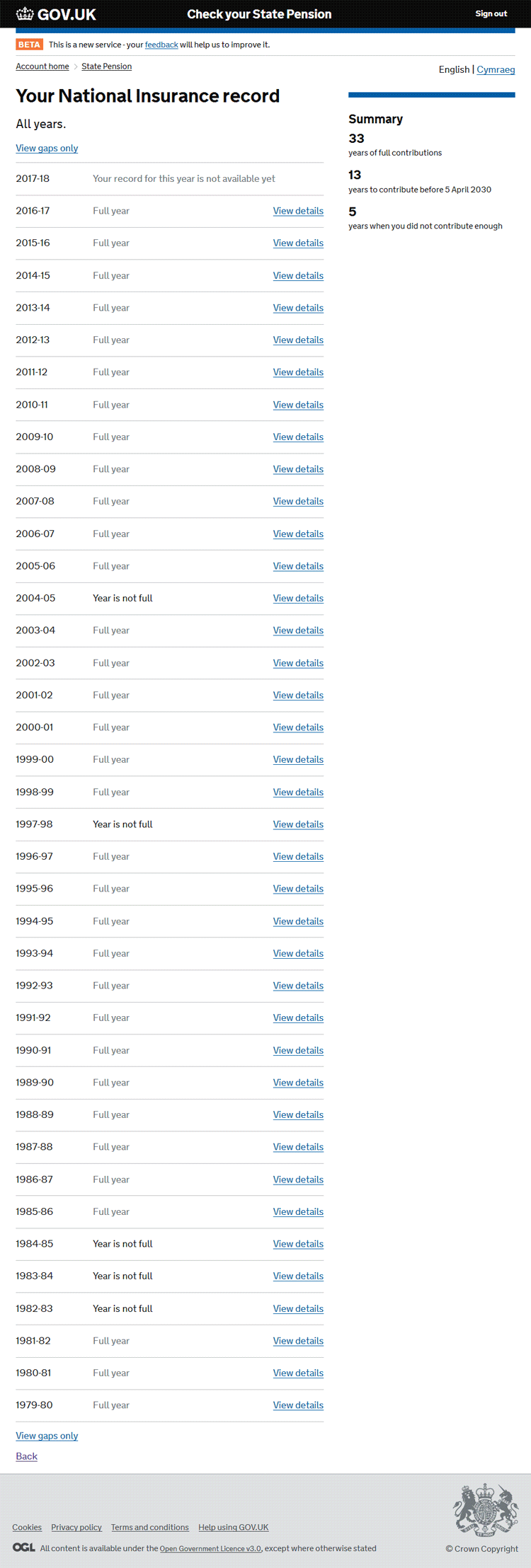
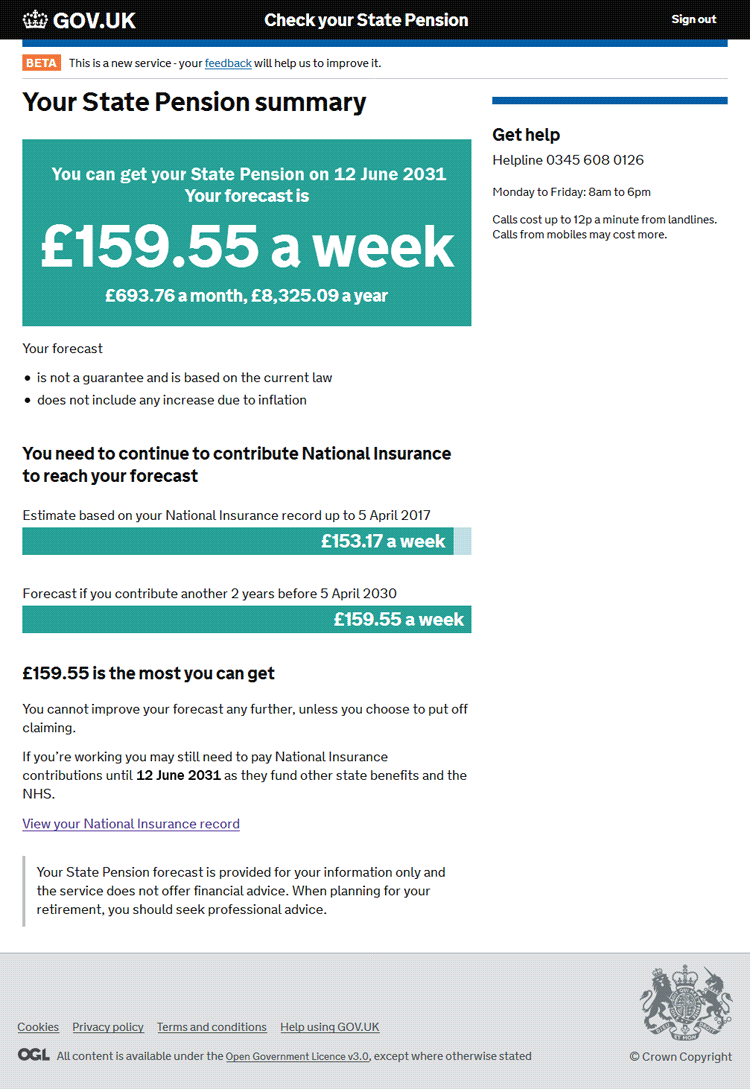
First, though, perhaps you’d like to sign up to view your PTA account for the first time. If you do this you can perhaps follow along with our notes and see how similar records in your PTA are to those in our demonstration account. For example, we found the National Insurance Record and resulting State Pension Forecast of particular interest, but that’s just indicative of many different areas available in the new PTAs. Before starting, though, take a look at our quick word about security* because it’s important to keep your personal details safe and out of harm’s way.
Anyway, if and when you’d like to take a look at your own PTA, head off to this page which will give you various options depending on whether you already have a Government Gateway account (to clarify, you will need a Government Gateway account before you can gain access to your PTA). If you’ve used HMRC online services before, you’ll already have a Government Gateway account. If not, follow the instructions on that page in order to set one up for the first time. To do that, you’ll need your National Insurance (NI) number and proof of identity which can include your bank account details, a P60, your 3 most recent payslips or your passport number and expiry date. It takes about 15 minutes to set up if you have these to hand.
When first logging in as a new user, the HMRC system may prompt you to set up an additional level of login security. For example, setting up access codes by SMS (you’ll then be sent a code to enter into the screen when logging in, to prove you are who you say you are. You’ll be sent a new access code to your mobile phone every time you sign in. It’s rather like 2FA (2 Factor Authentication) for those who are familiar with that).
You may additionally be asked some security questions, again to protect your data from hackers. In my test I was asked for my full name, date of birth, passport number and similar information (quite a bit actually). This type of heavy duty disclosure is another reason to make sure you have read our security* pointers before disclosing anything sensitive online.
Welcome to your Personal Tax Account (PTA)
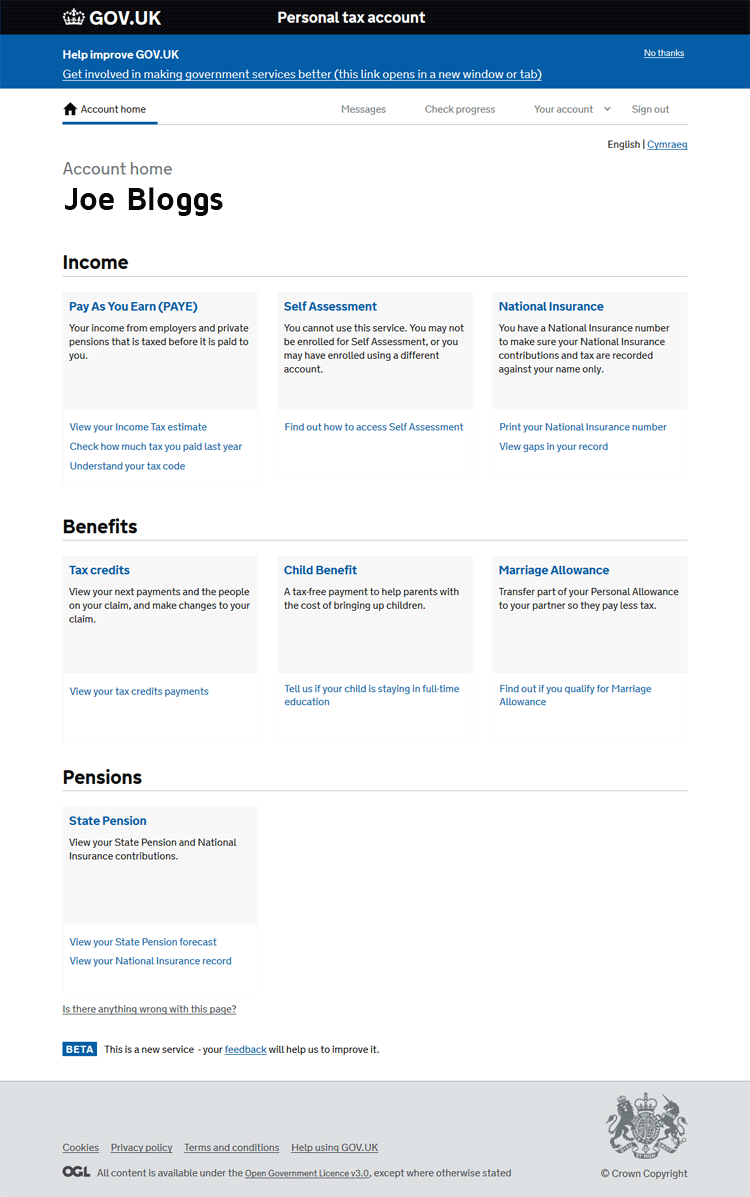
Once logged in you’ll be met with a screen similar to the image shown right, with your name at the top:
As you can see, it contains several sections. From your Personal Tax Account, you can:
Check your PAYE tax code, see an estimate of the Income Tax you’ll pay and more;
Check your Self Assessment details (or enrol) and view personal tax returns submitted in the past;
View your National Insurance record;
Check and amend your Tax Credits record;
Tell HMRC about any changes that might affect any Child Benefit you receive (e.g. tell HMRC if your child is staying in education or training if they were aged 16 on or before 31 August);
View and potentially update details about any Marriage Allowance if applicable to you (if you’re married or in a civil partnership and earn less than £11,500 you may be eligible);
View an entire history of your National Insurance (NI) contributions;
Check when you can claim your State Pension;
See a forecast of how much you may receive for your State Pension when the time comes.
https://www.taxfile.co.uk/wp-content/uploads/2017/10/Making-Tax-Digital-Header.jpg566849Markhttps://www.taxfile.co.uk/wp-content/uploads/2020/03/taxfile-logo-2020.pngMark2017-10-30 16:21:102021-10-31 19:48:54Making Tax Digital (‘MTD’), Part 1 — Your Personal Tax Account
Starting on 1 April 2018, a brand new tax system, one that will affect most business owners in the UK, will begin to roll out. Whether you’re a landlord, are working for yourself as a sole trader or have a limited company, the changes will affect you.
So what’s happening?
Instead of a once-a-year tax return, HMRC will require quarterly profit and loss information. So, that’s four times a year. For Taxfile clients, that means we’ll need to know all your income and expenses during every quarter so that we can make the necessary financial data available, on your behalf, to HMRC. As well as your bank statements, we’ll need to see receipts for the expenses, whether they’re provided physically or via a suitable electronic medium (there are plenty of apps and software packages for this purpose). Once we have everything for the quarter in question, we will be able to make sure that you’re claiming for all the allowable expenses that you are eligible for and aren’t claiming for things that you shouldn’t, so that your figures are absolutely correct.
If you don’t file in time there could be an HMRC penalty, so letting Taxfile handle your quarterly reporting will help to keep you on track seamlessly when the new changes come into force. We’ll be able to confirm our own pricing nearer the time but it’s likely to be circa just £75 per quarter, excluding VAT.
A ‘cash basis’ system
The new tax system will be known as a ‘Cash Basis’ system and will also allow tax to be paid to HMRC on a pay-as-you-go (PAYG) basis. Essentially, it means that businesses need only calculate their profits based on receipts and payments, which is far more straight forward than the more complex system that currently exists. When integrated into the Government’s new ‘digital tax accounts’, the system will really help to simplify tax, make budgeting and cash-flow easier through near real-time reporting and eventually remove the need for the traditional tax return at the end of the year — that’ll eventually be the case for virtually everyone. As an added bonus it’ll also mean that business owners keep more on top of their bookkeeping and thereby avoid a last minute scramble to update records. Taxpayers will also be able to see a complete financial picture of their tax affairs in the one place — their digital account — and all their liabilities and entitlements will be clear to see and manage more effectively than ever.
Taxfile
Nearer the time the changes come into place, Taxfile will be there to help its customers adapt to the new system and between us we’ll make sure that it’s easy and hassle-free. We’ll be able to Read more
https://www.taxfile.co.uk/wp-content/uploads/2016/11/Tax-reforms-featured.jpg450450Markhttps://www.taxfile.co.uk/wp-content/uploads/2020/03/taxfile-logo-2020.pngMark2016-11-21 09:15:542021-10-31 19:57:12Big Changes Coming to the Tax System
We may request cookies to be set on your device. We use cookies to let us know when you visit our websites, how you interact with us, to enrich your user experience, and to customize your relationship with our website.
Click on the different category headings to find out more. You can also change some of your preferences. Note that blocking some types of cookies may impact your experience on our websites and the services we are able to offer.
Essential Website Cookies
These cookies are strictly necessary to provide you with services available through our website and to use some of its features.
Because these cookies are strictly necessary to deliver the website, refusing them will have impact how our site functions. You always can block or delete cookies by changing your browser settings and force blocking all cookies on this website. But this will always prompt you to accept/refuse cookies when revisiting our site.
We fully respect if you want to refuse cookies but to avoid asking you again and again kindly allow us to store a cookie for that. You are free to opt out any time or opt in for other cookies to get a better experience. If you refuse cookies we will remove all set cookies in our domain.
We provide you with a list of stored cookies on your computer in our domain so you can check what we stored. Due to security reasons we are not able to show or modify cookies from other domains. You can check these in your browser security settings.
Other external services
We also use different external services like Google Webfonts, Google Maps, and external Video providers. Since these providers may collect personal data like your IP address we allow you to block them here. Please be aware that this might heavily reduce the functionality and appearance of our site. Changes will take effect once you reload the page.