Have you ever thought about your pension? It might seem far away, but it’s super important to start thinking about it now! One of the key things that helps build your future pension is your National Insurance (NI) contributions.
What are NI Contributions?
Think of NI contributions like little building blocks for your future. When you work and earn money, some of that money goes towards your NI. These contributions help you qualify for things like the State Pension when you’re older.
Why is it Important to Check?
Sometimes, there might be gaps in your NI record. Maybe you didn’t earn enough in a year, were travelling, or something else happened. If you have gaps, it could mean you get less State Pension later on.
The Good News: You Can Fill the Gaps!
You can often fill these gaps by making voluntary NI contributions to fill the gaps between 2006 to 2018 This means you pay a bit extra now to make sure you have a stronger pension later.
Big Deadline Alert! April 5th, 2025
There’s a really important deadline coming up: April the 5th, 2025. This is the last day you can pay voluntary NI contributions to fill certain gaps in your record. After the 5th of April 2025, everyone will only be able to pay for voluntary contributions for the past 6 years.
Why the Rush?
Boost your pension because filling gaps means a bigger pension in the future.
Don’t miss out — after the 5th of April 2025, everyone will only be able to pay for voluntary contributions for the past 6 years.
See if you have gaps — look for any years where you didn’t contribute enough.
Think about voluntary contributions. If you have gaps, consider paying voluntary contributions.
Need Help? Taxfile Can Help!
If you’re feeling a bit confused or need help understanding your NI record, don’t worry! Taxfile is here to help. We can explain everything clearly and help you make the right decisions for your future.
https://www.taxfile.co.uk/wp-content/uploads/2025/03/Pension-need-you.jpg561900Taxfilehttps://www.taxfile.co.uk/wp-content/uploads/2020/03/taxfile-logo-2020.pngTaxfile2025-03-20 17:15:202025-03-21 10:54:52Don’t Miss Out! Your Future Pension Needs YOU! – Check Your NI Contributions by April 5th, 2025
As we approach retirement, ensuring a comfortable financial future becomes a top priority. The state pension, a crucial source of retirement income, is dependent on the number of qualifying years of National Insurance (NI) contributions you have made. While gaps in your NI record can diminish your state pension entitlement, there’s a solution: voluntary NI contributions.
To receive the full state pension, you need 35 qualifying years of NI contributions. These years typically accumulate as you work, with contributions automatically deducted from your salary. However, there may be instances where you may not have earned enough to make mandatory NI contributions, leading to gaps in your record. Read more
https://www.taxfile.co.uk/wp-content/uploads/2023/12/Boost-State-Pension-FEATURE.jpg572829Taxfilehttps://www.taxfile.co.uk/wp-content/uploads/2020/03/taxfile-logo-2020.pngTaxfile2023-12-15 18:10:332025-03-13 12:33:59Boost Your State Pension with Voluntary National Insurance Contributions
The original deadline for buying National Insurance ‘credit’ was 31st July 2023, but you can now ‘buy’ incomplete years to boost your state pension until 5th April 2025. The extension was approved by the Government, giving HMRC more time to deal with the process.
https://www.taxfile.co.uk/wp-content/uploads/2023/06/Penison_deadline.jpg146650Taxfilehttps://www.taxfile.co.uk/wp-content/uploads/2020/03/taxfile-logo-2020.pngTaxfile2023-06-15 10:32:152023-06-15 11:55:46Deadline for Voluntary Insurance Contributions Extended to 5th April 2025
This is a question we often face from new company directors, how to pay yourself from the company.
As part of our £375+VAT package for a new limited company we offer the following;
company formation (including the option to have the company phrased as a special purpose vehicle for a property rental company)
we will register a single director with HMRC for self-assessment
we set up the payroll scheme
we arrange your chart of accounts on online software and set up the bank feed so transactions are automatically recorded
So the two ways to get paid are in the form of a monthly salary run from a payroll set up by the limited company and the second way is through dividend allocations based on the company’s annual post-tax profit.
A salary is treated as an expense to the business, therefore decreasing profits, reducing corporation tax, and in turn, minimising the amount of dividends available to then be attributed to each shareholder.
We suggest (correct as of the 23/24 tax year) a salary of £9,096 per annum (£758 p/m) as this is the minimum amount to qualify for a state pension (also known as the secondary threshold). If there are 2 or more directors (on the secondary threshold or above) or any additional staff on the payroll above the secondary threshold for the company, the Employment Allowance offered by the government becomes available, giving the company £5,000 ‘pot’ towards the employer’s NI contributions.
If the company posts a profit, the value of the post-tax profit can be allocated as dividends to the shareholder(s) of the company. If there is more than one shareholder, then the dividends are allocated dependent on the percentage of shares held by each shareholder.
Unfortunately, the tax efficiency of dividends is being reduced. For the 22/23 tax year there is a £2,000 tax-free allowance, for 2023/24 there will only be a £1,000 tax-free allowance and for 2024/25 it has been stated that it will be halved again to £500.
The amount of tax you pay on dividends will be dependent on your income tax band which includes your tax-free allowance, and any earnings from the limited company and any other earnings outside.
This will need to be declared on a self-assessment tax return to HMRC, which covers the period of the UK tax year from 6th April to 5th April every year.
As part of our £375+VAT package we can enrol one shareholder/director onto the self-assessment scheme with HMRC to obtain a Unique Tax Reference (UTR) to allow them to comply with their personal tax obligations in the future. Contact us on 020 8761 8000 for more information.
https://www.taxfile.co.uk/wp-content/uploads/2023/05/Payroll.jpg9911917Taxfilehttps://www.taxfile.co.uk/wp-content/uploads/2020/03/taxfile-logo-2020.pngTaxfile2023-05-23 16:19:052023-05-24 15:33:40How do I pay myself as a Director?
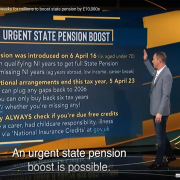
IMPORTANT: the video mentions the original deadline in April 2023. This has now been extended to 5th April 2025.
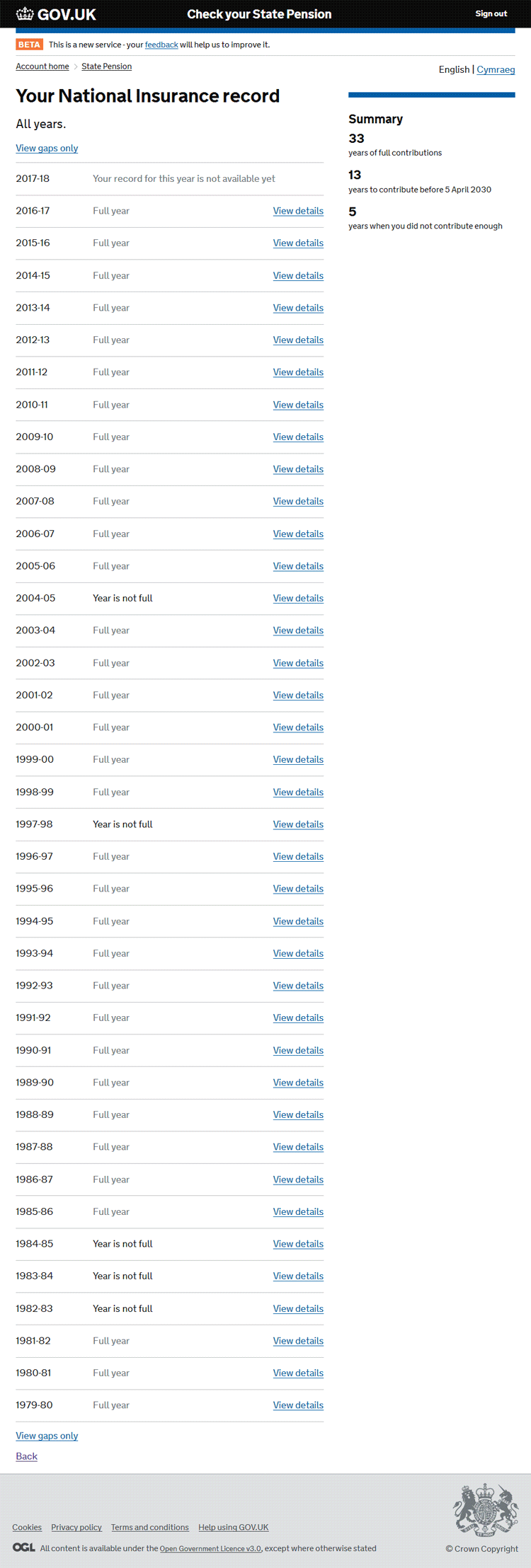
Do you have gaps in your National Insurance record? If so, it could mean that you could get a lower State Pension when you reach state retirement age, particularly if you are aged between approximately 45 and 70 at the moment. Generally speaking, you need 10 years of contributions for a basic state pension and around 30 to 35 years for a full state pension. It does vary by circumstance though and, even with gaps, some people might have enough qualifying years for the full state pension already.
Urgently Check Whether You Have National Insurance Gaps
Our advice is to urgently check whether you do have any gaps in your National Insurance record. If so, in many cases it would be wise to make some one-off payments to plug any gaps for the years 2006 to 2016. However, there is limited time to do so despite the deadline for this opportunity having been extended from early April to the end of July 2023 [UPDATE: This has now been extended again to 5th April 2025]. Thereafter, the chance to fix all 11 years from 2006 to 2016 will be gone forever. Read more
https://www.taxfile.co.uk/wp-content/uploads/2023/04/NI-boost-to-State-Pension.jpg900900Markhttps://www.taxfile.co.uk/wp-content/uploads/2020/03/taxfile-logo-2020.pngMark2023-04-21 10:24:042025-03-13 15:08:20Boost State Pension by Plugging Gaps in National Insurance
HMRC have been busy, behind the scenes, shaking things up with regard to the personal data they hold on UK taxpayers. They’ve been pulling in – rather successfully – personal data from various different government departments and bringing all that data into one central place for both them and us to see, whenever the need arises. This is all part of their longer-term plan for Making Tax Digital or ‘MTD’ as it’s known in the tax and accounting world. So, with that in mind, this is the first in a series of posts that introduces MTD and a crucial part of that; Personal Tax Accounts (PTAs). In this series of articles we’ll discuss what MTD will mean for most of us, we’ll look at the kinds of data that will be stored, see how it’ll affect us and, lastly, see if there is anything that we’ll need to do.
Personal Tax Accounts (PTAs)
One of the core elements of MTD is the Personal Tax Account (PTA). In years to come, each UK individual is likely to become very used to logging into their Personal Tax Account on the HMRC website. In fact, these already exist and most, if not all, UK taxpayers can already access them if they want to. When accessed, it’s quite interesting to see the huge amount of data already accessible via your own PTA if you care to take a look. You may be surprised just how much data they contain for you.
For those not yet ready to take the plunge, we’ve taken a look for you, as you’ll see. And, so far, we are quite impressed.
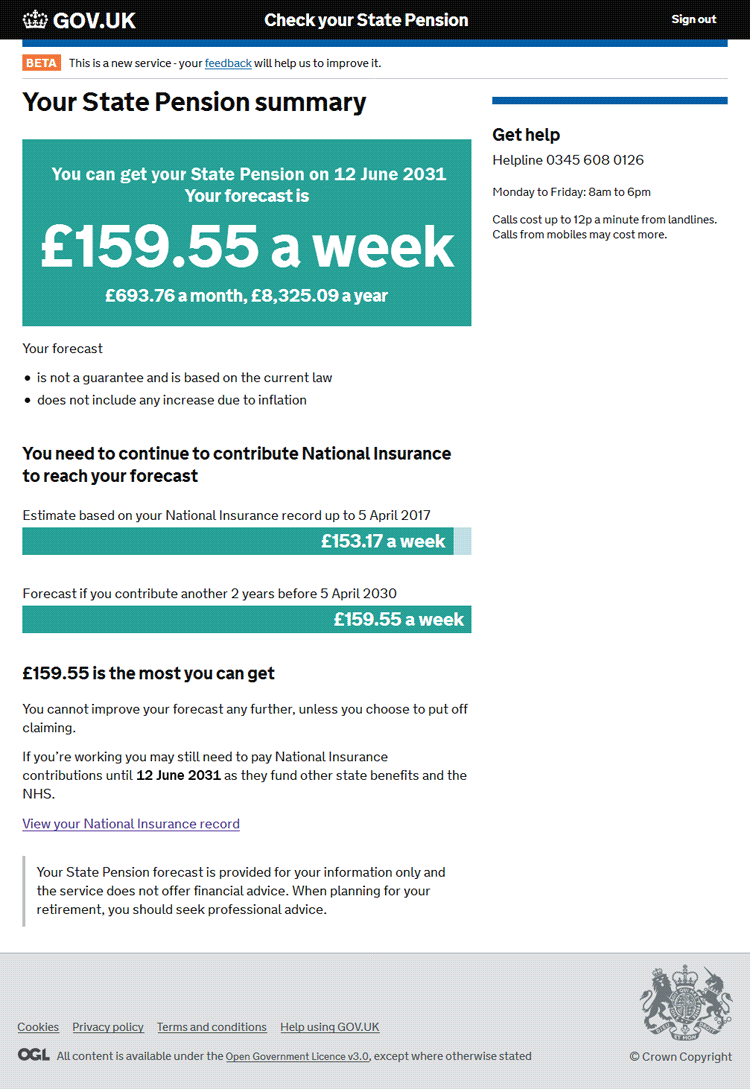
First, though, perhaps you’d like to sign up to view your PTA account for the first time. If you do this you can perhaps follow along with our notes and see how similar records in your PTA are to those in our demonstration account. For example, we found the National Insurance Record and resulting State Pension Forecast of particular interest, but that’s just indicative of many different areas available in the new PTAs. Before starting, though, take a look at our quick word about security* because it’s important to keep your personal details safe and out of harm’s way.
Anyway, if and when you’d like to take a look at your own PTA, head off to this page which will give you various options depending on whether you already have a Government Gateway account (to clarify, you will need a Government Gateway account before you can gain access to your PTA). If you’ve used HMRC online services before, you’ll already have a Government Gateway account. If not, follow the instructions on that page in order to set one up for the first time. To do that, you’ll need your National Insurance (NI) number and proof of identity which can include your bank account details, a P60, your 3 most recent payslips or your passport number and expiry date. It takes about 15 minutes to set up if you have these to hand.
When first logging in as a new user, the HMRC system may prompt you to set up an additional level of login security. For example, setting up access codes by SMS (you’ll then be sent a code to enter into the screen when logging in, to prove you are who you say you are. You’ll be sent a new access code to your mobile phone every time you sign in. It’s rather like 2FA (2 Factor Authentication) for those who are familiar with that).
You may additionally be asked some security questions, again to protect your data from hackers. In my test I was asked for my full name, date of birth, passport number and similar information (quite a bit actually). This type of heavy duty disclosure is another reason to make sure you have read our security* pointers before disclosing anything sensitive online.
Welcome to your Personal Tax Account (PTA)
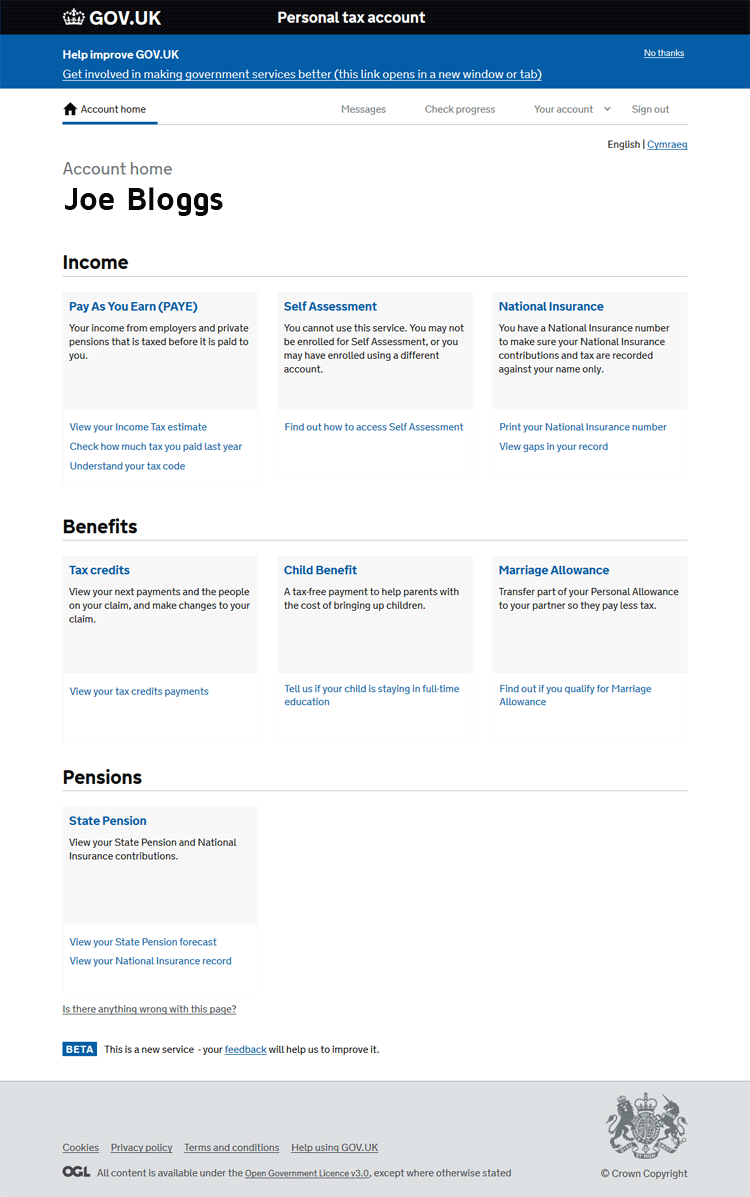
Once logged in you’ll be met with a screen similar to the image shown right, with your name at the top:
As you can see, it contains several sections. From your Personal Tax Account, you can:
Check your PAYE tax code, see an estimate of the Income Tax you’ll pay and more;
Check your Self Assessment details (or enrol) and view personal tax returns submitted in the past;
View your National Insurance record;
Check and amend your Tax Credits record;
Tell HMRC about any changes that might affect any Child Benefit you receive (e.g. tell HMRC if your child is staying in education or training if they were aged 16 on or before 31 August);
View and potentially update details about any Marriage Allowance if applicable to you (if you’re married or in a civil partnership and earn less than £11,500 you may be eligible);
View an entire history of your National Insurance (NI) contributions;
Check when you can claim your State Pension;
See a forecast of how much you may receive for your State Pension when the time comes.
https://www.taxfile.co.uk/wp-content/uploads/2017/10/Making-Tax-Digital-Header.jpg566849Markhttps://www.taxfile.co.uk/wp-content/uploads/2020/03/taxfile-logo-2020.pngMark2017-10-30 16:21:102021-10-31 19:48:54Making Tax Digital (‘MTD’), Part 1 — Your Personal Tax Account
We may request cookies to be set on your device. We use cookies to let us know when you visit our websites, how you interact with us, to enrich your user experience, and to customize your relationship with our website.
Click on the different category headings to find out more. You can also change some of your preferences. Note that blocking some types of cookies may impact your experience on our websites and the services we are able to offer.
Essential Website Cookies
These cookies are strictly necessary to provide you with services available through our website and to use some of its features.
Because these cookies are strictly necessary to deliver the website, refusing them will have impact how our site functions. You always can block or delete cookies by changing your browser settings and force blocking all cookies on this website. But this will always prompt you to accept/refuse cookies when revisiting our site.
We fully respect if you want to refuse cookies but to avoid asking you again and again kindly allow us to store a cookie for that. You are free to opt out any time or opt in for other cookies to get a better experience. If you refuse cookies we will remove all set cookies in our domain.
We provide you with a list of stored cookies on your computer in our domain so you can check what we stored. Due to security reasons we are not able to show or modify cookies from other domains. You can check these in your browser security settings.
Other external services
We also use different external services like Google Webfonts, Google Maps, and external Video providers. Since these providers may collect personal data like your IP address we allow you to block them here. Please be aware that this might heavily reduce the functionality and appearance of our site. Changes will take effect once you reload the page.