Changes in EU VAT is incoming from 1st July 2021 for Business to Customer (B2C) sales for those operating within the EU. The changes need to also be considered for businesses in the UK, post-Brexit, that wish to sell online directly to the customer.
The new EU VAT E-commerce package is comprised of two key components;
One Stop Shop (OSS)
Import One Stop Shop (IOSS)
It is not compulsory to report VAT using either of these methods, the option is still available to register for VAT in each EU country you wish to do trade with and account and pay VAT in each of those territories. However, reading that, you would wonder why you would take on such a task, when you can just do one VAT return, where the liabilities are then paid to each country where the B2C transaction occurred. However, importantly, these 2 methods can only be used for Read more
https://www.taxfile.co.uk/wp-content/uploads/2021/06/Brexit-VAT.jpg250500Taxfilehttps://www.taxfile.co.uk/wp-content/uploads/2020/03/taxfile-logo-2020.pngTaxfile2021-06-01 17:30:312021-10-31 15:10:52EU VAT – The BREXIT Effect
According to HMRC, ‘cryptoassets’ are cryptographically secured digital representations of value or contractual rights that can be:
transferred
stored
traded electronically
There are various types of cryptoassets including exchange tokens, utility tokens, and security tokens. HMRC does not consider cryptocurrency to be currency or money & their complete Cryptoassets Manual can be found HERE.
As far taxes are concerned, investing in cryptocurrency is akin to investing in other assets such as stocks, bonds, and the sale of rental properties. This means that capital gains and losses rules apply when you ‘dispose’ your assets, and in this case your cryptocurrency.
HMRC explains that disposals include:
selling cryptocurrency for money
exchanging cryptocurrency for a different type of cryptocurrency
using cryptocurrency to pay for goods or services
giving away cryptocurrency to another person
Any of the above situations subject any profits to Capital Gains Tax (CGT) and the simple formula for calculating capital gains (or losses) is:
Fair Market Value – Cost = Profit or Loss
The fair market value is the market price of the asset at the time that you sold, traded, or disposed of it. The cost is the price you paid at the time of the purchase.
Although this is a simple and logical calculation, calculating CGT on your profits becomes a bit more complex when you have multiple transactions to account for. The UK requires a specific type of method for calculating the cost basis of your coins known as Shared Pool Accounting also known as a 104 Pool.
With the shared pooled accounting method, you are essentially Read more
Are you late paying your tax? Do you owe unpaid tax for the last financial year, or earlier? Are you struggling to pay it?
Taxfile has recently been helping some of our customers with tax debts from 2019/20 and earlier. In particular, we’re helping them to arrange payment plans with HMRC as part of their ‘Time to Pay‘ scheme. This spreads the cost of those tax debts instead of paying them off in one go. This is really useful to those who are struggling financially following the pandemic. The new payment plans are only available until 1 April 2021, though, so really you should apply by 31 March 2021. Our advice is to act now if you are in a position to take advantage of the payment plans while they’re still — just about — available.
The benefits of arranging a tax payment plan now
Agreeing a payment plan with HMRC will help avoid the 5% late payment penalty that’s usually charged on outstanding tax not paid by the deadline. And, of course, spreading the cost helps those who might otherwise struggle to get together the full amount in one transaction. The HMRC interest rate seems relatively low too.
https://www.taxfile.co.uk/wp-content/uploads/2021/03/Payment-Plans-Expiring.jpg537894Markhttps://www.taxfile.co.uk/wp-content/uploads/2020/03/taxfile-logo-2020.pngMark2021-03-31 09:00:242021-10-31 15:15:32Tax “Payment Plans” are ENDING – Act NOW if you Owe Tax!
In The Chancellor’s 2021 budget speech it was announced that the furlough scheme would be extended until the end of September 2021, to protect the jobs and livelihoods of the UK population during the pandemic.
The Government will pay employees 80% of the hours not worked through to the end of June 2021. As the country opens up it will then offer 70% with the employer to contribute the other 10%, then in August through to the end of September they will ask the employer to pay 20% while the Government covers the remaining 60%, so the employee continues to receive the 80% of their income for the hours not worked.
If you or your business need help setting up a payroll and help with the furlough scheme, then please do not hesitate to contact us on 020 8761 8000.
https://www.taxfile.co.uk/wp-content/uploads/2021/03/Job_retention_scheme.jpg258500Taxfilehttps://www.taxfile.co.uk/wp-content/uploads/2020/03/taxfile-logo-2020.pngTaxfile2021-03-03 13:43:122021-10-31 15:17:31Furlough Scheme Extended until End of September
HM Revenue and Customs (HMRC) has announced that Self Assessment taxpayers will not be charged a 5% late payment penalty if they pay their tax or set up a payment plan by 1st April 2021.
Normally, a 5% late payment penalty is also charged on any unpaid tax that is still outstanding on 3rd March. But this year, because of the impact of the COVID-19 pandemic, HMRC is giving taxpayers more time to pay or to set up a payment plan.
Taxpayers have until 28th February 2021 to file any pending tax returns and prevent being charged a late filing penalty (of £100). They then have until 01/04/2021 to pay any outstanding tax or make an arrangement with HMRC for a payment plan before they receive a late payment penalty.
We encourage any of our clients that are struggling to meet their tax obligations to set up a payment plan to spread the cost into monthly instalments. More information can be found on the Government website HERE. You will be able to spread the cost of their self assessment tax bill through to January 2022.
If you have any questions, please do not hesitate to contact us on 020 8761 8000 or, if you still have a 2019/20 tax return to submit, then we can help you get this in on time to avoid the £100 late filing penalty. We will be open on Saturday the 27th & Sunday 28th February.
https://www.taxfile.co.uk/wp-content/uploads/2021/02/Late_Payment_Penalty_Relief.jpg533800Taxfilehttps://www.taxfile.co.uk/wp-content/uploads/2020/03/taxfile-logo-2020.pngTaxfile2021-02-23 14:40:222021-10-31 15:20:075% Late Payment Penalty Relief Announced by HMRC
Don’t miss our latest newsletter. Published just this week, it includes several updates on the latest Government support for small businesses during the pandemic, including:
a possible 4th SEISS grant coming for the self-employed and …
extensions of both the Job Retention Scheme (‘furlough’) ….
and Bounce-Back Loan Scheme.
There’s also a useful link where you can check what help may be available to you using a simple but genius interactive interface.
The newsletter also includes imminent deadlines that may affect you and news about a significant VAT change that will affect the entire Construction Sector.
Have you submitted your Self-Assessment tax return for the year 2019-20? It’s due in a few days! Learn more in the newsletter or get the ball rolling here.
Have you paid any tax you owe for the same period? It’s now overdue if not. Also see the newsletter for more information contact us using the yellow buttons below.
Learn much more about all these topics and more in our latest e-Newsletter, which can be viewed here. For help with any tax or accounting related issue, simply contact us and we’ll be happy to help. Choose an option below …
Money Saving Expert founder Martin Lewis has announced¹ exclusive news about a possible 4th SEISS Grant for self-employed people. The Self-Employment Income Support Scheme (SEISS) offers direct financial support from the Government for those self-employed people who have seen a significant drop in profits due to the coronavirus pandemic, where eligible. He says the official announcement is currently scheduled for 3rd March 2021 during the Chancellor of the Exchequer’s Spring Budget.
Applications for the current 3rd SEISS grant closed on the 29th of January. The fourth SEISS grant period will cover the months February, March and April. Martin’s exclusive information suggests:
“… there will not be an announcement made on the amount of that grant and who is eligible […] until the budget, which is on the third of March. So over a month after the grant period starts, there won’t be news on exactly how much money you can get, and who is going to get it.”
He goes on to say:
“I doubt this actually means that people will receive their money any later, relatively, than they have done in the prior grants, because you’ve never been able to apply on the first day of the period”
Martin goes on to confirm that he suspects Read more
https://www.taxfile.co.uk/wp-content/uploads/2021/02/SEISS-Grant-4-announcement.jpg5931053Markhttps://www.taxfile.co.uk/wp-content/uploads/2020/03/taxfile-logo-2020.pngMark2021-02-10 15:29:562025-03-13 14:31:06SEISS Grant 4 – News Coming Soon!
Yesterday HMRC made an 11th hour decision to give the remaining 3 million tax payers an additional 28-days to file their tax return electronically.
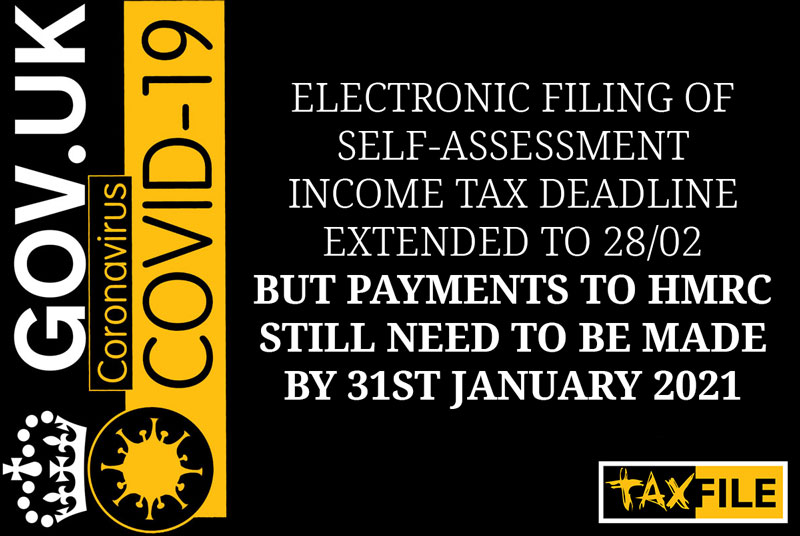
For most, a submission after the 31st of January would have resulted in a £100 late filing penalty. With planning already underway at HMRC on how to cope with the administrative task of appeals around COVID & late filing, HMRC has decided to only issue the penalties after 28th February, effectively offering a 1-month extension on the electronic submission of self-assessment income tax.
However, the payment date for taxes remains unchanged, so it is important to note that taxpayers are still obliged to pay any tax they still owe (including any deferred payments) by 31/01. In fact we are advising our clients to pay as much as they can into their HMRC self-assessment account and to view it as a bank account with HMRC so that, once their taxes are filed, they are not left with any unwanted surprises with interest on late payments, as any unpaid tax from 19/20 will be charged interest as of 01/02.
The extension has been welcomed and our own Director Guy Bridger had approached the Treasury requesting this extension. so even though there is a sense of relief, we are adamant that tax payers realise they need to settle their outstanding tax bill if they can, even if it is an estimate, otherwise they will face HMRC’s low rate of annual interest on late payment of taxes along with the initial surcharge of 5% of any tax unpaid for the 19/20 tax year after 28-days. So Guy’s suggestion is to pay as much tax as you can before 28th of February.
Please view your UTR as a bank account with HMRC, and any money paid into HMRC’s account with your UTR is money that will sit on your account until it needs to be used up.
So, even though your taxes can now be filed electronically by no later than 28/02, you will need to pay money into your HMRC account by 31/01. If you still need us to calculate and submit your 19/20 taxes, please come and see us or call us on 020 8761 8000. Even though we might not file them before the 31st January, you will at least know the outstanding amount owed.
https://www.taxfile.co.uk/wp-content/uploads/2021/01/Deadline_for_payments_unchanged.jpg536800Taxfilehttps://www.taxfile.co.uk/wp-content/uploads/2020/03/taxfile-logo-2020.pngTaxfile2021-01-26 13:12:362021-10-31 15:22:34HMRC Extends the Self-Assessment Submission Deadline to 28th February BUT Payments still need to be made by 31st January
[BREAKING NEWS:] 11 days ago we published a post confirming that Guy Bridger, Taxfile’s founder, had personally delivered a postcard to No. 10 Downing Street, making the case for an extension to the Self-Assessment tax return deadline until the end of February. In Guy’s postcard to Boris Johnson, he had argued that there was simply too much pressure on people during Christmas, the New Year and the month of January, due to the bottleneck caused by the Self Assessment tax return deadline.
Well, in some very welcome good news, it seems the Government has listened to Guy’s plea. This afternoon HMRC confirmed:
“Self Assessment customers will not receive a penalty for filing their 2019-20 tax return late, as long as they file online by 28 February.”
They went on to say:
“We are still encouraging customers who have not yet filed to do so by 31 January, if possible.”
This is great news for the people of the UK, in what are otherwise challenging times. Tens of thousands of accountants across the nation will also be hugely relieved. We also suspect that under-pressure HMRC staff will be happy about this development. Accountants and taxpayers across the UK may well be queueing to buy Guy a drink when the pubs re-open!
It’s important to realise, however, that the tax owed for the tax year 2019-20 will still be due by 31 January. HMRC will charge interest from 1 February as usual. Guy’s company Taxfile is here to help compute the figures, though. For those who wish to take advantage and submit tax returns online during the February extension, but also want pay tax by 31 January in order to avoid interest, we have now published some further guidance here on what to do. That new guidance will help even if you’re not yet 100% sure of the figures, so take a look via that bold link.
Contact Taxfile for Help with Tax Returns & Any Tax-Related Issue
To contact Guy Bridger or any of the helpful tax experts at his company Taxfile, simply get in touch. We’re here to help!
Guy Bridger, Taxfile’s founder, has personally delivered a post card to Boris Johnson. He recently slipped it under the door of Number 10 Downing Street (there is no letterbox!).
The Issue with the Tax Return Deadline – & Guy’s Suggested Solution
In his communication to Boris, Guy suggested that the tax return filing deadline should be permanently extended, for example to the end of February, instead of 31 January as it is currently. In his proposed scenario, people would have longer to file their tax return. As well as taking the pressure off over Christmas, New Year and during January, this later deadline would also mean less likelihood of receiving a surcharge on the possible tax debt they owed for the last tax year’s calculation. Taking this a step further and with the help of video journalist David Gyimah, Guy has also been making a documentary about the tax return filing deadline and the immense pressure it puts people under during Christmas and the New Year — and especially during the entire month of January.
In contrast, limited company businesses currently have 9 months in which to file their accounts to Companies House and at the same time pay their taxes. Interestingly, they have 12 months to file their Corporation Tax return.
Guy & Taxfile
Guy has worked in South London for 25 years, dealing with members of the public and their tax responsibilities. At Taxfile, he has long-serving, thoughtful staff on hand six, sometimes seven, days a week every January. This is a measure of just how much work the current tax return deadline causes during this key accounting month every year. Taxfile makes it their task to remind — even nag — every customer about the deadline, as most of them will have to submit a Self-Assessment tax return by 31 January.
Consulting with the Office of Tax Simplification
Guy Bridger’s last visit to the Treasury was when he worked with The Office of Tax Simplification, resulting in the recognition that people actually prepare their self-employed accounts on a cash basis.
When Guy worked with John Whiting there, the other theme he was interested in was the idea that people who were sole traders perhaps didn’t need to form a limited company. This was because, in agreement with John and many members of the consultation body, it was our view that Read more
We may request cookies to be set on your device. We use cookies to let us know when you visit our websites, how you interact with us, to enrich your user experience, and to customize your relationship with our website.
Click on the different category headings to find out more. You can also change some of your preferences. Note that blocking some types of cookies may impact your experience on our websites and the services we are able to offer.
Essential Website Cookies
These cookies are strictly necessary to provide you with services available through our website and to use some of its features.
Because these cookies are strictly necessary to deliver the website, refusing them will have impact how our site functions. You always can block or delete cookies by changing your browser settings and force blocking all cookies on this website. But this will always prompt you to accept/refuse cookies when revisiting our site.
We fully respect if you want to refuse cookies but to avoid asking you again and again kindly allow us to store a cookie for that. You are free to opt out any time or opt in for other cookies to get a better experience. If you refuse cookies we will remove all set cookies in our domain.
We provide you with a list of stored cookies on your computer in our domain so you can check what we stored. Due to security reasons we are not able to show or modify cookies from other domains. You can check these in your browser security settings.
Other external services
We also use different external services like Google Webfonts, Google Maps, and external Video providers. Since these providers may collect personal data like your IP address we allow you to block them here. Please be aware that this might heavily reduce the functionality and appearance of our site. Changes will take effect once you reload the page.