
Posts

Don't Miss Out! Your Future Pension Needs YOU! - Check Your NI Contributions by April 5th, 2025

Don’t Miss Out! Your Future Pension Needs YOU! – Check Your NI Contributions by April 5th, 2025

Don't Miss Out! Your Future Pension Needs YOU! - Check Your NI Contributions by April 5th, 2025

By Mohamed at Taxfile.

Have you ever thought about your pension? It might seem far away, but it’s super important to start thinking about it now! One of the key things that helps build your future pension is your National Insurance (NI) contributions.

What are NI Contributions?

Think of NI contributions like little building blocks for your future. When you work and earn money, some of that money goes towards your NI. These contributions help you qualify for things like the State Pension when you’re older.

Why is it Important to Check?

Sometimes, there might be gaps in your NI record. Maybe you didn’t earn enough in a year, were travelling, or something else happened. If you have gaps, it could mean you get less State Pension later on.

The Good News: You Can Fill the Gaps!

You can often fill these gaps by making voluntary NI contributions to fill the gaps between 2006 to 2018 This means you pay a bit extra now to make sure you have a stronger pension later.

Big Deadline Alert! April 5th, 2025

There’s a really important deadline coming up: April the 5th, 2025. This is the last day you can pay voluntary NI contributions to fill certain gaps in your record. After the 5th of April 2025, everyone will only be able to pay for voluntary contributions for the past 6 years.

Why the Rush?

  • Boost your pension because filling gaps means a bigger pension in the future.
  • Don’t miss out — after the 5th of April 2025, everyone will only be able to pay for voluntary contributions for the past 6 years.

What Should You Do?

  1. Check your NI record — it’s free and easy! You can check your NI record online through the government’s website.
  2. See if you have gaps — look for any years where you didn’t contribute enough.
  3. Think about voluntary contributions. If you have gaps, consider paying voluntary contributions.

Capital Gains Tax Hike: A Blow to Investors

Capital Gains Tax Hike: A Blow to Investors

Capital Gains Tax Hike: A Blow to Investors

October 2024’s Autumn Budget delivered a significant blow to investors with the announcement of increased Capital Gains Tax (CGT) rates. Today, we explore the new rates, how they will affect the sale of assets, and how investors can mitigate their effects.

The New Capital Gains Tax Rates

Effective from 30th October 2024, the basic rate of CGT will rise from 10% to 18%, and the higher rate will increase from 20% to 24%.

What This Means for Investors

These changes will make it more expensive for investors to realise gains from selling assets like shares, bonds, and cryptocurrency. This could lead to a number of consequences, including:

  • Reduced investment activity — investors may be less inclined to sell assets, particularly if they expect to make significant gains;
  • A shift towards tax-efficient investments — investors may seek out tax-efficient investments, such as ISAs and pensions;
  • A greater need for tax planning — investors may require more sophisticated tax planning strategies to minimise tax liabilities.

How Can Investors Mitigate the Impact of the CGT Increases?

Investors have several ways to mitigate the worst effects of the CGT rate increases. They can:

  1. Seek professional advice — a good tax advisor like Taxfile can help investors understand the full impact of the changes and develop a tax-efficient strategy;
  2. Review their investment portfolios to identify the potential tax implications of the new CGT rates;
  3. Utilise tax-efficient investments, for example, through the use of tax-efficient wrappers like ISAs and pensions;
  4. Time investments wisely — carefully timing the sale of assets may help to significantly reduce CGT liabilities.

Understanding Basis Period Reform for Self-Assessment Tax in the UK

Understanding Basis Period Reform for Self-Assessment Tax in the UK


Understanding Basis Period Reform for Self-Assessment Tax in the UK

Are you a sole trader or in a partnership? 

Do you have different accounting dates from the standard 6th of April to the 5th of Apri?

If you answered YES to both questions, some IMPORTANT changes will apply for the tax year 2023-24.

The concept of the basis period determines the time frame used to calculate taxable profits or losses for self-employed individuals, partnerships, and some trusts.  It marks a departure from the traditional “current year” basis, where business profits were taxed based on the accounting period ending within the tax year. Instead, it introduces a “tax year” basis, aligning taxable profits with the UK’s standard tax year, running from 6 April to 5 April. Read more

VAT in the UK: a comprehensive guide including what it is, the different rates, registering, returns, reclaiming it, the different schemes and more.

Navigating the VAT Landscape in the UK: A Comprehensive Guide

VAT in the UK: a comprehensive guide including what it is, the different rates, registering, returns, reclaiming it, the different schemes and more.

Value Added Tax (VAT), a consumption tax levied on most goods and services in the UK, plays a significant role in the nation’s economy. Whether you’re a sole trader, limited company business owner or simply a curious consumer, understanding VAT is crucial for navigating the UK’s tax system effectively. Today’s comprehensive guide explains what it is, the various VAT rates, when you need to be registered for the tax, VAT schemes, and more. Read more

TODAY is the deadline for submission of your tax return. Contact Taxfile for help filing & avoid a minimum £100 fine!

31st January was the Self Assessment Tax Return Deadline!

Today (31 January) is the self-assessment tax return deadline!

[As at 1 February 2023]: The 31st January was the Self Assessment tax return and tax payment deadline. Miss the deadline and you’ll be in for a £100 HMRC fine right away. Interest will also be charged from 1 February, as usual, if tax is not paid by midnight on 31 January (rules apply). Time is short, so contact Taxfile for help with your tax return as soon as possible please. Book an appointment* with one of our helpful tax advisors and accountancy experts TODAY — we’ll make it easy!

020 8761 8000 Book Appointment Get Started Here
Read more

Key Takeaways from the Spring Statement 2022

Key Takeaways from the Spring Statement 2022

Key Takeaways from the Chancellor of the Exchequer's Spring Statement 2022

The Chancellor Rishi Sunak unveiled his Spring Statement for 2022 on 23 March and in some ways it was more like a mini budget.

Key takeaways from the Spring Statement include:

  • The earnings threshold at which you start to pay National Insurance Contributions (NICs) will increase to £12,570 from July 2022. This is currently set at £9,880 (correct at time of writing, March 2022), so will leave people with more money in their pockets.
  • Class 2 NICs for the self-employed will also reduce, from April 2022, to zero for profits between £6,515 and £9,568
  • 5p per litre has been cut immediately from fuel duty.
  • The basic rate of income tax will reduce from 20% to 19% starting in April 2024.
  • The Employment Allowance will increase to £5,000 per annum from April 2022. Currently it’s set at £4,000. The allowance reduces the NICs that employers have to pay.
  • VAT on materials that save energy will be reduced from 5% to zero from April 2022. This should reduce the cost of things like solar panels, heat pumps and insulation.
  • Councils in England will be able to pass on their share of an additional £500m in extra Government support via the Household Support Fund. The new tranche is for the period 2022/23. The fund helps vulnerable residents, via councils, with short-term help with things like fuel and household bills, food, clothing and other essentials. The previous tranche ends on 31 March 2022, so this is timely.

Watch the Chancellor’s 28 minute Spring Statement 2022, as delivered to the House of Commons, in the video above (skip any adverts). Alternatively get all the detail in the House’s briefing summary here. There’s also a Read more

New Taxfile Brochure - Download Here

New Taxfile Brochure – Download Here

New Taxfile Brochure - Download Here.

The new Taxfile brochure is out and you can download it here. Even if you’re an existing client, it’s worth taking a look in case we can help you in ways you weren’t aware of. We can help anyone e.g. the self-employed, directors of limited companies, partners in partnerships, sole traders, retired people, landlords, taxi and cab drivers, construction workers and just about anyone.

The new brochure covers:

  • Self-assessment income tax returns;
  • Services for SMBs;The new brochure from Taxfile - accountants and tax advisers in Tulse Hill, Dulwich, South London & the South West.
  • Accounts work for limited companies;
  • Bookkeeping and bank reconciliation;
  • Payroll & PAYE tax and National Insurance, company pensions and more;
  • VAT help, including for VAT schemes, registration and VAT returns;
  • Company pensions (auto-enrolment etc.);
  • Corporation Tax returns;
  • Confirmation Statements;
  • Making Tax Digital (MTD);
  • CIS calculations and tax rebates for construction workers;
  • Help with tax complications;
  • Taxfile brochure - inside spread.Dealing with HMRC on your behalf;
  • Joining or leaving various tax schemes;
  • Capital Gains Tax (CGT) calculations and handling;
  • Tax calculations relating to property income for landlords;
  • Disclosures of income not previously taxed (e.g. from abroad);
  • And much more.

Forward to a Friend – Free Consultation

Please feel free to forward the new Taxfile brochure to a friend who could benefit from our accountancy and tax-related services. We offer a free 20-minute consultation for new clients, without obligation.

020 8761 8000 Book Appointment Download Brochure

We are open 6 days a week during February including Saturday mornings (by appointment) and later opening (until 6pm) on Mondays and Tuesdays.

Taxfile's Autumn Newsletter 2021

Taxfile’s Autumn Newsletter 2021

Taxfile's Autumn Newsletter 2021

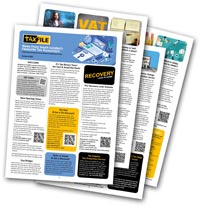
Our tax and accountancy-related newsletter is available as a PDF download tooWelcome to Taxfile’s Autumn Newsletter for 2021. One of our biggest yet, it includes useful tax- and accountancy-related news that you need to be aware of, ways to save time or money – and much more. Take a look!

QR Codes

QR codes are quick links you can scan on your mobile phoneYou’ll find QR codes throughout the newsletter. These are a quick and easy way to access further information about the topic. Assuming you are viewing the newsletter on a desktop device or a printed* version, simply point your mobile camera phone at a QR code and then open the link that pops up. Your mobile’s browser will then take you straight to the information page. Alternatively, we supply simple link URLs to simply tap in.

Acrobat PDF version availableDownload As an Acrobat PDF & Print Out

* If you’re viewing on a small screen, it may be easier to read if you download the newsletter as an Acrobat PDF so you can print it out at full size (A4). Read more