Posts

Guide to the Employer Payment Summary (EPS) – for Limited Companies within the CIS

Guide to the Employer Payment Summary (EPS) – for Limited Companies within the CIS

by Daniel at Taxfile.

Understanding the Employer Payment Summary (EPS) monthly claims for limited companies within the CIS

Limited company contractors operating within the Construction Industry Scheme (CIS) have distinct payroll obligations, including the submission of their Employer Payment Summary (EPS). In today’s guide, we’ll explain what the EPS is, its purpose, and the submission rules limited companies have to follow if they work within the Construction Industry Scheme.

What is the EPS?

The Employer Payment Summary serves as a crucial mechanism for limited company contractors to report additional payments, deductions, and adjustments to HM Revenue & Customs (HMRC) alongside their regular payroll submissions. While all such employers submit a monthly EPS, limited company contractors operating under CIS have specific considerations due to their status and the nature of their work within the construction industry.

The purpose of submitting monthly EPSs for Limited Company Contractors in the CIS

The primary purpose of EPSs for limited company contractors operating within the CIS is to provide HMRC with accurate information about deductions suffered under the Construction Industry Scheme. By submitting each monthly EPS for CIS, limited company contractors also ensure compliance with CIS regulations and provide HMRC with essential data for tax calculations and entitlements.

Submitting an EPS for Limited Company Contractors working within the CIS

Limited company contractors operating within CIS are required to submit an EPS to HMRC every month, even if there are no adjustments to report. EPSs should be submitted after the end of the tax month but before the 19th of the following month, in line with HMRC guidelines.

Contractors can use HMRC’s online services or compatible payroll software to submit their monthly EPS for CIS. It’s crucial to ensure that the information provided in each EPS accurately reflects the deductions suffered under CIS.

The CIS deductions suffered sent through an EPS are promptly reflected as a credit on the PAYE account. This credit will then be utilised to set off against other liabilities, including PAYE tax, National Insurance Contributions (NIC), and subcontractor’s tax submitted through the CIS300 return.

When sending the EPS you can also claim Employment Allowance and recover statutory payments that exceed the amount of PAYE due.

Submitting EPSs late may lead to penalties imposed by HMRC, which can vary based on the extent and frequency of delays.

Understanding Overpayment Relief – Types, Eligibility & How to Claim

Understanding Overpayment Relief

Understanding Overpayment Relief – Types, Eligibility & How to Claim

by Mohamed at Taxfile.

Have you ever felt that you’ve paid more in taxes than necessary? Whether due to calculation errors, changes in personal circumstances, or evolving tax laws, overpayments can happen to anyone. The good news is that there’s a way to reclaim those excess funds through the process of overpayment relief claims. In this comprehensive guide, we’ll walk you through the ins and outs of reclaiming your hard-earned money.

What is Overpayment Relief?

Overpayment relief allows you to recover money you’ve mistakenly paid to HMRC within four years after the end of the tax year in which the overpayment occurred. It’s a financial safety net that allows you to correct discrepancies and regain control of your finances. Understanding the concept is the first step toward putting your overpaid taxes back where they belong – in your pocket.

Types of Overpayment

The overpayment must be for income tax, capital gains tax (CGT), Class 4 National Insurance contributions (NICs), or corporation tax. It applies to both overpayments and excessive assessments.

Eligibility Criteria

You must have a valid reason for believing you overpaid tax. This could be an error in your tax return, incorrect coding by HMRC, or changes in your circumstances affecting your tax liability. You cannot claim overpayment relief simply by correcting your tax return after the deadline.

Claiming Overpayment Relief

You need to submit a formal claim to HMRC in the correct format, explicitly stating that it’s for “overpayment relief.”

The claim should clearly identify the tax year, the amount you believe you overpaid, and the reason for the overpayment. Include any supporting evidence, like documents confirming income, deductions, or expenses. Your claim must be submitted within specific time frames — generally, four years from the end of the tax year for which you’re claiming. Special rules apply for late claims.

Claim Format

Your claim must be made in writing, stating the tax year, the amount overpaid, the reason for your claim, and whether you’ve previously appealed. You cannot claim through your tax return.

For more information please refer to the HMRC website or get in touch with Taxfile.

Tax & Accountancy Help from Taxfile

At Taxfile we are skilled at identifying opportunities for additional savings, deductions, and credits that individuals might overlook. You can call us on 020 8761 8000 to schedule a free 20-minute, no-obligation consultation for any tax-related matter — or simply use the buttons below:

Taxfile is a tax advisor and accountant in Tulse Hill at 25 Thurlow Park Road, Tulse Hill, London SE21 8JP. We’re on the corner at the junction of Birkbeck Hill and the South Circular (A205), within easy walking distance of Tulse Hill station (map). We also have a Dulwich office.

Basis Reform and Spreading

Basis Reform and Spreading

Basis Period Reform and Spreading of Tax Over Multiple Years
As of April 6, 2023, the Self-Assessment (SA) for income tax has undergone a significant transformation, known as Basis Period Reform.  This change aims to align the taxation of business profits with the standard April-April tax year, rather than any other accounting periods that may have been required by the taxpayer.

While the transition to the new basis period has introduced certain complexities, it also presents opportunities for businesses to manage their tax liabilities more effectively. One such opportunity lies in the spreading of tax arising from transitional profits.

Transitional profits refer to the profits that arise from the transition between the old and new basis periods. These profits can be spread over Read more

Understanding Basis Period Reform for Self-Assessment Tax in the UK

Understanding Basis Period Reform for Self-Assessment Tax in the UK


Understanding Basis Period Reform for Self-Assessment Tax in the UK

Are you a sole trader or in a partnership? 

Do you have different accounting dates from the standard 6th of April to the 5th of Apri?

If you answered YES to both questions, some IMPORTANT changes will apply for the tax year 2023-24.

The concept of the basis period determines the time frame used to calculate taxable profits or losses for self-employed individuals, partnerships, and some trusts.  It marks a departure from the traditional “current year” basis, where business profits were taxed based on the accounting period ending within the tax year. Instead, it introduces a “tax year” basis, aligning taxable profits with the UK’s standard tax year, running from 6 April to 5 April. Read more

Pension Contribution Deadline Extended

Deadline for Voluntary Insurance Contributions Extended to 5th April 2025

Deadline for Voluntary Insurance Contributions Extended to 5th April 2025

The original deadline for buying National Insurance ‘credit’ was 31st July 2023, but you can now ‘buy’ incomplete years to boost your state pension until 5th April 2025. The extension was approved by the Government, giving HMRC more time to deal with the process.

You can view our original blog on what you need to do to plug the gaps in your National Insurance contributions here.

Boost State Pension by Plugging Gaps in National Insurance

Boost State Pension by Plugging Gaps in National Insurance

IMPORTANT: the video mentions the original deadline in April 2023. This has now been extended to 5th April 2025.

Do you have gaps in your National Insurance record? If so, it could mean that you could get a lower State Pension when you reach state retirement age, particularly if you are aged between approximately 45 and 70 at the moment. Generally speaking, you need 10 years of contributions for a basic state pension and around 30 to 35 years for a full state pension. It does vary by circumstance though and, even with gaps, some people might have enough qualifying years for the full state pension already.

Urgently Check Whether You Have National Insurance Gaps

Our advice is to urgently check whether you do have any gaps in your National Insurance record. If so, in many cases it would be wise to make some one-off payments to plug any gaps for the years 2006 to 2016. However, there is limited time to do so despite the deadline for this opportunity having been extended from early April to the end of July 2023 [UPDATE: This has now been extended again to 5th April 2025]. Thereafter, the chance to fix all 11 years from 2006 to 2016 will be gone forever. Read more

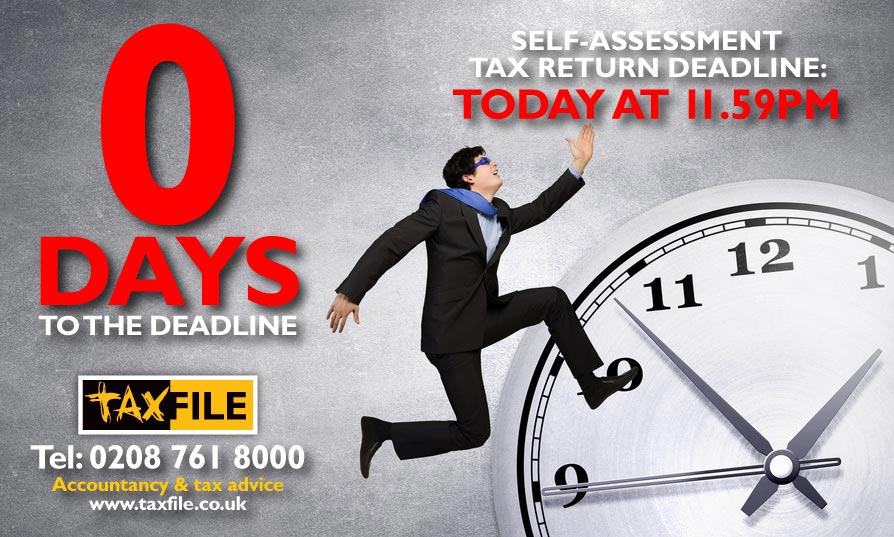
TODAY is the deadline for submission of your tax return. Contact Taxfile for help filing & avoid a minimum £100 fine!

31st January was the Self Assessment Tax Return Deadline!

Today (31 January) is the self-assessment tax return deadline!

[As at 1 February 2023]: The 31st January was the Self Assessment tax return and tax payment deadline. Miss the deadline and you’ll be in for a £100 HMRC fine right away. Interest will also be charged from 1 February, as usual, if tax is not paid by midnight on 31 January (rules apply). Time is short, so contact Taxfile for help with your tax return as soon as possible please. Book an appointment* with one of our helpful tax advisors and accountancy experts TODAY — we’ll make it easy!

020 8761 8000 Book Appointment Get Started Here
Read more

Key Takeaways from the Spring Statement 2022

Key Takeaways from the Spring Statement 2022

Key Takeaways from the Chancellor of the Exchequer's Spring Statement 2022

The Chancellor Rishi Sunak unveiled his Spring Statement for 2022 on 23 March and in some ways it was more like a mini budget.

Key takeaways from the Spring Statement include:

  • The earnings threshold at which you start to pay National Insurance Contributions (NICs) will increase to £12,570 from July 2022. This is currently set at £9,880 (correct at time of writing, March 2022), so will leave people with more money in their pockets.
  • Class 2 NICs for the self-employed will also reduce, from April 2022, to zero for profits between £6,515 and £9,568
  • 5p per litre has been cut immediately from fuel duty.
  • The basic rate of income tax will reduce from 20% to 19% starting in April 2024.
  • The Employment Allowance will increase to £5,000 per annum from April 2022. Currently it’s set at £4,000. The allowance reduces the NICs that employers have to pay.
  • VAT on materials that save energy will be reduced from 5% to zero from April 2022. This should reduce the cost of things like solar panels, heat pumps and insulation.
  • Councils in England will be able to pass on their share of an additional £500m in extra Government support via the Household Support Fund. The new tranche is for the period 2022/23. The fund helps vulnerable residents, via councils, with short-term help with things like fuel and household bills, food, clothing and other essentials. The previous tranche ends on 31 March 2022, so this is timely.

Watch the Chancellor’s 28 minute Spring Statement 2022, as delivered to the House of Commons, in the video above (skip any adverts). Alternatively get all the detail in the House’s briefing summary here. There’s also a Read more

New Taxfile Brochure - Download Here

New Taxfile Brochure – Download Here

New Taxfile Brochure - Download Here.

The new Taxfile brochure is out and you can download it here. Even if you’re an existing client, it’s worth taking a look in case we can help you in ways you weren’t aware of. We can help anyone e.g. the self-employed, directors of limited companies, partners in partnerships, sole traders, retired people, landlords, taxi and cab drivers, construction workers and just about anyone.

The new brochure covers:

  • Self-assessment income tax returns;
  • Services for SMBs;The new brochure from Taxfile - accountants and tax advisers in Tulse Hill, Dulwich, South London & the South West.
  • Accounts work for limited companies;
  • Bookkeeping and bank reconciliation;
  • Payroll & PAYE tax and National Insurance, company pensions and more;
  • VAT help, including for VAT schemes, registration and VAT returns;
  • Company pensions (auto-enrolment etc.);
  • Corporation Tax returns;
  • Confirmation Statements;
  • Making Tax Digital (MTD);
  • CIS calculations and tax rebates for construction workers;
  • Help with tax complications;
  • Taxfile brochure - inside spread.Dealing with HMRC on your behalf;
  • Joining or leaving various tax schemes;
  • Capital Gains Tax (CGT) calculations and handling;
  • Tax calculations relating to property income for landlords;
  • Disclosures of income not previously taxed (e.g. from abroad);
  • And much more.

Forward to a Friend – Free Consultation

Please feel free to forward the new Taxfile brochure to a friend who could benefit from our accountancy and tax-related services. We offer a free 20-minute consultation for new clients, without obligation.

020 8761 8000 Book Appointment Download Brochure

We are open 6 days a week during February including Saturday mornings (by appointment) and later opening (until 6pm) on Mondays and Tuesdays.