How we harness technology at Taxfile in Tulse Hill, Dulwich, Devon & Cornwall

Harnessing Technology at Taxfile

How we harness technology at Taxfile in Tulse Hill & Dulwich, South East London

The rapid pace of technological change has caused some of the biggest shifts in how we view and process our tax returns. At Taxfile, we’re constantly striving to use technology as effectively as possible to aid us in collecting, analysing, and collaborating when working on your personal data.

Over the pandemic, we’ve had to place our reliance even further on technology to maintain our standards, with regular meetings online. We’re constantly improving the efficiency of our work pipeline and, with the ability to pull figures directly from online bank statements, we can ensure precision in the numbers we present you with. For the last two years, we’ve implemented cloud technology as both a collaborative tool between our senior and junior staff and as storage for various databases used to track everything from employee working hours to the status of your tax return. We’re expanding further on this concept in collaboration with Pure Technology by merging our existing cloud systems with our current remote work solution to form one, all-encompassing workspace environment. Hosting it in the Microsoft Cloud ensures that, with the help of our office staff, your paperwork and bookings can be sent to and viewed by your tax agent as soon as possible. This and a variety of other endeavours are examples of our ambitions to be at the forefront of innovations, and constant review of our policies ensures we remain ahead, or on track, to meet the standards set by Making Tax Digital (MTD) for its 2023 launch.

Contact South London’s Favourite Accountant

Taxfile can help you with all your tax or accountancy requirements. We offer Read more

Are you self employed? If so, Joe from Taxfile has some quick advice for you

Are you self employed? Advice from Taxfile

Are you self employed? Joe from Taxfile has some quick advice for you

Are you self employed? If so, Joe from Taxfile has some quick advice for you:

Class 2 National Insurance

It is important to register for Class 2 National Insurance. A lot of people don’t have this set up correctly and, if not sorted, then it can greatly affect your pension in the future. Class 2 National Insurance isn’t a lot of money, so speak to one of our advisors to make sure you’re set up. Finding out missing years is also possible.

Tax Returns

Try to file your tax return early. A major benefit to this is knowing what your tax liability will be long before it is due. That way, you can plan ahead or even set up a payment plan.

If you are filing your return late, then it is very important to try to get up to date as soon as you can. Apart from the initial £100 penalty for late returns, you will eventually end up paying a £10 per day penalty too if you don’t get up to date soon enough. That can soon spiral out of control. HMRC is very good at helping people who are struggling, but they can’t help if you bury your head in the sand. Penalties for late tax returns can be appealed but you must have very a good reason, like illness or death in the family.

Are you claiming the right expenses?

Speak to one of our agents about allowable expenses. A lot of people don’t claim the right expenses and can end up overpaying their tax. We can help with that, so you save unnecessary tax.

Contact Taxfile

Speak to Taxfile for any of your tax needs. Our staff skills are so versatile that, between us, there is nothing accounting- or tax-related that we can’t help with.

Call Taxfile on 020 8761 8000 or email your tax-related query and we’ll be happy to help. We also offer a free 20-minute introductory appointment if you’d like to meet us in person or virtually through a video or telephone call — whatever you prefer. We are accountants and tax advisors in Tulse Hill/Dulwich South London.

This post was brought to you by Joe at Taxfile.

PAYE, 2021/22 Tax Thresholds, Employment Allowance & P800s

PAYE, 2021/22 Tax Thresholds, Employment Allowance & P800s

PAYE, 2021/22 Tax Thresholds, Employment Allowance & P800s

My name is Daniel and I have been a part of the Taxfile family since 2007. It started as a part-time job doing bookkeeping, but as time went on, I developed new abilities and a deeper understanding of the tax world. PAYE, VAT, and Company Register are now my areas of expertise.

I understand how complicated the tax world is, so here are a few PAYE things to consider:

Understanding the tax thresholds for 2021-2022

PAYE is calculated based on how much you earn and whether you are eligible for the personal allowance.

  • Standard Rate: PAYE income tax is charged at 20%, less a personal allowance of £12,570, this is signified by tax code 1257L.
  • Higher Rate: For most, income over £50,270 to £150,000 is charged at 40%.
  • Additional Rate: Income above £150,000 is charged at 45%.

What is the Employment Allowance?

The Employment Allowance allows certain businesses that employ workers to reduce their annual National Insurance (NI) bill by up to £4,000 (for the 2021/22 tax year).
Eligible businesses can claim a reduction against their employer’s Class 1 NI liability up to a maximum of £4,000 each tax year. You can still claim the allowance if the liability was less than £4,000 in a tax year.

You can’t claim if you’re a company with only one employee paid above the Class 1 National Insurance Secondary Threshold (£8,840 for the 2021/22 tax year, up from £8,788 for the 2020/21 tax year) if that employee is also a director of the company.

How will I know if I haven’t paid the right amount of PAYE?

HMRC will send out a P800 tax calculation form after the tax year ends on 5 April, which you should receive by the end of November. This will show how much tax is due to be refunded, or is owed for previous years.

Another significant aspect of Taxfile is that it works with a wide range of accounts software (Sage, QuickBooks, Xero, FreeAgent, VT, Forbes, Moneysoft, and so on) and can accommodate everyone. These are just a few examples, but if you need assistance with any area of PAYE, VAT, or other types of tax, Taxfile and the team are here to help. Call Taxfile on 020 8761 8000, book a free appointment (in-person and phone or video call options are available) or simply message us your tax-related query and we’ll be happy to help. We are accountants and tax experts in South London.

This post was brought to you by Daniel at Taxfile.

Get peace of mind by using an experienced and friendly team of tax advisers and accountants

Peace of Mind from Using an Experienced Tax Team

Get peace of mind by using an experienced and friendly team of tax advisers and accountants

When using Taxfile, you are using an experienced team that will make dealing with your tax affairs seamless. A lot of clients start by coming into our office stressed and overwhelmed, not knowing where to start. Using your current position and needs, we plan a step-by-step approach to keep you on top of your affairs and the relationship between you and HMRC harmonious. Once you are officially on board with us, we will have access to your HMRC record and, with our dedicated agent lines to HMRC, we’ll be able to speak to them on your behalf. This way, you are free from having to call them yourself and wait longer than we do for a call handler. You can also have any issues or queries explained to you in an easy to understand way by our friendly team. If you receive any letters that from HMRC and you don’t understand anything, we will be able to take a look for you and explain what it’s all about.

Any fee you pay Taxfile is tax deductible, so will be put on your tax return and result in a reduction of tax.

Our up-to-date knowledge of the tax system will give you peace of mind, alleviate any anxiety you may have and make the whole experience very different to how a lot of people find it when they are not using a team like ours. We know the best way to approach a tax situation that, without our experience and knowledge, could otherwise result in a lot more time and money being spent unnecessarily. From something as small as missing a tax return deadline, it can spiral into something a lot bigger, potentially including penalties, late payment interest, debt collection agencies being involved and so on. We inform all our clients of upcoming deadlines, for their particular tax situation, and let them know what needs doing and when, avoiding this situation and many more.

Unlike a lot of other companies, our tax experts and accountants are approachable, accessible and happy to help. We’re a unique tax advisor and accountancy practice like no other, with offices in Tulse Hill and Dulwich. We can help with any tax-related issues, including bookkeeping, filling in a tax return, limited company accounts, help accounting for property lettings tax refunds and anything accountancy-related. Call Taxfile on 020 8761 8000, book a free 20-minute appointment with us (remote or in-person options available) or simply email us your tax-related query here.

This post was brought to you by Julie at Taxfile.

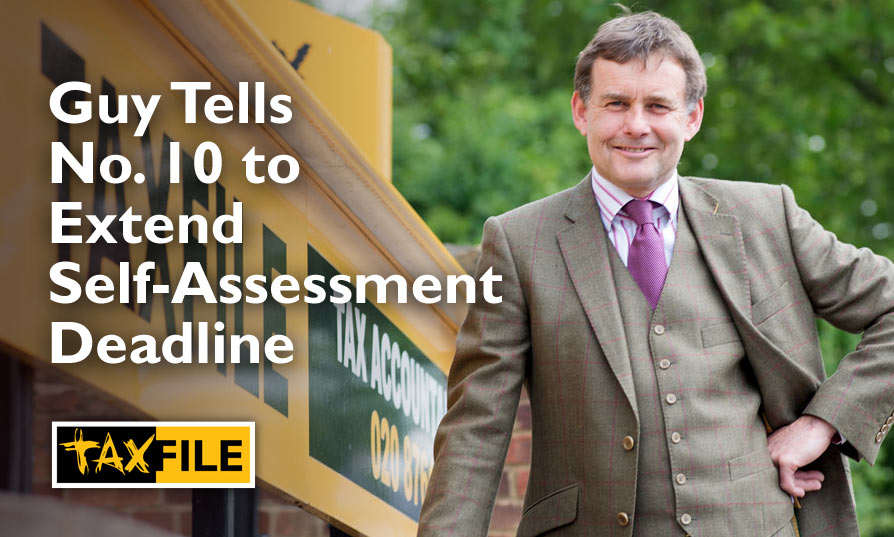
Guy Tells No. 10 to Extend Self-Assessment Deadline

BREAKING NEWS: No. 10 Heeds Guy’s Plea — & Extends Self-Assessment Deadline!

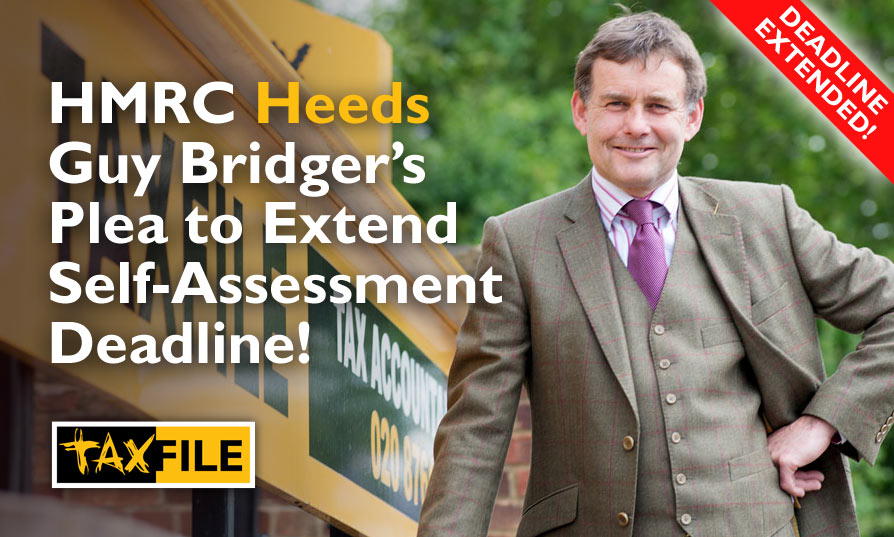
HMRC Heeds Guy's Plea & Extends Self-Assessment Deadline!

[BREAKING NEWS:] 11 days ago we published a post confirming that Guy Bridger, Taxfile’s founder, had personally delivered a postcard to No. 10 Downing Street, making the case for an extension to the Self-Assessment tax return deadline until the end of February. In Guy’s postcard to Boris Johnson, he had argued that there was simply too much pressure on people during Christmas, the New Year and the month of January, due to the bottleneck caused by the Self Assessment tax return deadline.

Well, in some very welcome good news, it seems the Government has listened to Guy’s plea. This afternoon HMRC confirmed:

“Self Assessment customers will not receive a penalty for filing their 2019-20 tax return late, as long as they file online by 28‌‌ ‌February.”

They went on to say:

“We are still encouraging customers who have not yet filed to do so by 31‌‌ January, if possible.”

This is great news for the people of the UK, in what are otherwise challenging times. Tens of thousands of accountants across the nation will also be hugely relieved. We also suspect that under-pressure HMRC staff will be happy about this development.  Accountants and taxpayers across the UK may well be queueing to buy Guy a drink when the pubs re-open!

It’s important to realise, however, that the tax owed for the tax year 2019-20 will still be due by 31 January. HMRC will charge interest from 1 February as usual. Guy’s company Taxfile is here to help compute the figures, though. For those who wish to take advantage and submit tax returns online during the February extension, but also want pay tax by 31 January in order to avoid interest, we have now published some further guidance here on what to do. That new guidance will help even if you’re not yet 100% sure of the figures, so take a look via that bold link.

Contact Taxfile for Help with Tax Returns & Any Tax-Related Issue

To contact Guy Bridger or any of the helpful tax experts at his company Taxfile, simply get in touch. We’re here to help!

Book an Appointment
Send us a Message
T: 020 8761 8000


You can learn more about Guy Bridger, his involvement at The Office of Tax Simplification and his company Taxfile here. If you would like to read Guy’s original article about the postcard given to Boris Johnson, click here.

Guy Tells No. 10 to Extend Self-Assessment Deadline

Guy Tells No. 10 to Extend Self-Assessment Deadline

Guy Tells No. 10 to Extend Self-Assessment Deadline

[THERE IS BREAKING NEWS ABOUT THIS POST – CLICK HERE FOR MORE DETAILS]

Guy Bridger, Taxfile’s founder, has personally delivered a post card to Boris Johnson. He recently slipped it under the door of Number 10 Downing Street (there is no letterbox!).

The Issue with the Tax Return Deadline – & Guy’s Suggested Solution

In his communication to Boris, Guy suggested that the tax return filing deadline should be permanently extended, for example to the end of February, instead of 31 January as it is currently. In his proposed scenario, people would have longer to file their tax return. As well as taking the pressure off over Christmas, New Year and during January, this later deadline would also mean less likelihood of receiving a surcharge on the possible tax debt they owed for the last tax year’s calculation. Taking this a step further and with the help of video journalist David Gyimah, Guy has also been making a documentary about the tax return filing deadline and the immense pressure it puts people under during Christmas and the New Year — and especially during the entire month of January.

In contrast, limited company businesses currently have 9 months in which to file their accounts to Companies House and at the same time pay their taxes. Interestingly, they have 12 months to file their Corporation Tax return.

Guy & Taxfile

Guy has worked in South London for 25 years, dealing with members of the public and their tax responsibilities. At Taxfile, he has long-serving, thoughtful staff on hand six, sometimes seven, days a week every January. This is a measure of just how much work the current tax return deadline causes during this key accounting month every year. Taxfile makes it their task to remind — even nag — every customer about the deadline, as most of them will have to submit a Self-Assessment tax return by 31 January.

Consulting with the Office of Tax Simplification

Guy Bridger’s last visit to the Treasury was when he worked with The Office of Tax Simplification, resulting in the recognition that people actually prepare their self-employed accounts on a cash basis.

When Guy worked with John Whiting there, the other theme he was interested in was the idea that people who were sole traders perhaps didn’t need to form a limited company. This was because, in agreement with John and many members of the consultation body, it was our view that Read more

Taxfile Partners with Local Government to Offer Self Assessment Assistance

With the self-assessment tax deadline looming in the midst of a global pandemic and no announcement of an extension from the government (28 days would do), 5.4m* taxpayers (45%) still needing to submit a tax return before the 31st January and many of those are left feeling hopeless and helpless, unsure how to complete it themselves and having difficulty finding or affording an accountant who can do it on their behalf.

Some will attempt to complete the tax return online themselves but without a Government Gateway ID that task will be impossible.  Obtaining the Government Gateway ID would require having their ID checked and confirmed online and without a valid UK passport and/or driving licence the task will lead to long phone calls on hold waiting for a HMRC advisor, who are currently running somewhat of a skeleton crew as a result of the pandemic (at least that’s the impression given due to the long waiting times even on the authorised agents helplines and the reduced opening hours).

Even if you do have Government Gateway ID (and password), you will need to work through HMRC’s Self-Assessment form, deciding which of the sections are relevant to you & compiling the information required for each part. Take a look at these help sheets especially useful for people with self-employed earnings (some of the business income references use the word business which can confuse as the rules and guidelines are equally applicable to sole traders working for themselves).

Also check out the HMRC’s toolkit: https://www.gov.uk/government/publications/hmrc-business-profits-toolkit.

 You will need to accurately assess all your business income and more so, expenses, ensuring the correct figures are entered and submitted.  Knowing what expenses you can and can’t claim can really have a negative or positive effect on the tax bill you will be presented with at the end but how do you ensure you are paying the correct amount of tax?

 Looking for assistance from HMRC’s website can provide some valuable information if you know what you are looking for (see the help sheets mentioned above) but from the distance, for the everyday taxpayer, this task can be rather daunting.  Finding personal help, assistance, and guidance can be difficult, especially when the people that can help those most are currently experiencing their busiest period in the industry whilst coping with the effects of COVID on their workforce.

Many may opt for the avoidance strategy until the £100 late filing penalty lands on their door and further threats of daily fines & interest kicks them into action.  You will have a ground to appeal any fines or penalties if you have been affected by COVID.  This will involve writing a formal letter to HMRC and providing any evidence they may request to overturn the fine.

We do recommend that however hard it maybe, it’s a good idea to put some money on your HMRC self-assessment account to settle last year’s tax if you can at least estimate it because at the end of February any tax still outstanding from the previous year which ended 05/04/20 will attract a surcharge which is almost impossible to appeal against so give it a go and work out your taxable profit and then put it in this calculator so you can guesstimate how much you need to rustle up.

If you need an injection to your cash flow even if you were eligible and claimed for the SEISS grants, we would strongly recommend you apply for the Bounce Back Loan Scheme (BBLS) if you have not done so already.  This can be done via your bank provider online & in many cases they may require you to open a business bank account.  You are then eligible for a maximum of 25% of your 2018/19 business turnover (a minimum of £2k and maximum amount of £50k being leant).  The interest rate for this loan is 2.5% for 6-years and the government will pay the interest for the first 12-months of the loan.

Taxfile is currently working closely with local government and our director is on the board of the local business improvement district, we like to think of ourselves as the local tax office for the people of south London, we may be able to give you a little help along the way so why not give us a call for a free 20 minute confidential chat on 020 8761 8000


*figure correct on 01/01/21

Don't miss THIS on your self-assessment tax return!

Don’t Miss THIS on your Tax Return! (Checklist)

Don't miss THIS on your self-assessment tax return! (Checklist)

The standard Self-Assessment Tax Return includes all the usual areas that you’d expect to have to confirm to HMRC. These include the obvious things like personal details, information about income for the period in question, any assets, dividends, interest received, pensions and so on.

However, there are a number of additional areas that you need to check and confirm before the return is submitted and filed with HMRC. It’s not an exhaustive list, but things people sometimes miss and that you need to check you have allowed for (if applicable) include:

  • Employment Income — have you confirmed any employment income? Have you supplied Taxfile, if we’re your tax agent or accountant, with copies of P60’s and P11D’s. Did you have any employment expenses?
  • Self-Employment Income or Partnership Income — have you confirmed any self-employed or partnership income and relevant expenses? Have you supplied all CIS vouchers, invoices, cash income etc. if applicable?
  • UK Land & Property Income — have you confirmed any rental income and relevant expenses for each property you perhaps rent out?
  • Foreign Income — did you receive any foreign income? Have you confirmed it?
  • Trust Income — did you receive any trust income or are you treated as having received any trust income?
  • Capital Gains — have you sold any assets or investments which may be subject to capital gains tax e.g. a rental house, stocks and shares etc?
  • Residence — were you, for all or part of the year, not resident, not ‘ordinarily resident’ or not ‘domiciled’ in the UK?
  • Investment Income — have you confirmed any bank/building society interest, dividends, etc?
  • Pension Income — are you in receipt of any? It needs confirming if so.
  • Any other income received that doesn’t fit into any of the above e.g. Job Seekers Allowance, Tax Credits? Child Benefit is an important one, especially if one parent is earning £50k or more. Marriage Allowance is another.
  • Do you have a pension that you pay into? If so, how much did you pay for the period in question?
  • Have you given any money to charity? Higher rate taxpayers can usually get extra tax relief on this.
  • Do you have a student loan?
  • Are you subject to the High Income Benefit Charge?
  • Do you use a service company?
  • Have you been paying your National Insurance?
  • Have you been keeping good records?

Taxfile will always prompt you to check for things like these if you’re our customer, before we submit your tax return on your behalf. As we say above, though, the list is not an exhaustive one, so there may be other information we need, depending upon your individual situation. The list of what HMRC requires each year also Read more

Watch out for scam emails, texts & calls

Watch Out – Fraudsters Are About!

Watch out for scam emails, texts & calls

Have you noticed a significant increase in the number of scam calls, phishing emails and dodgy texts to your mobile in recent weeks? We certainly have. Some of Taxfile’s customers have been asking if any are genuine, so we thought we’d send out this warning

If you receive a call, email or text from HMRC asking for your personal or financial details, it’s simple: DO NOT to give ANY information away via text, email or to someone calling you by telephone. They could be anyone! Your information will be used against you if it gets into the wrong hands — and that could potentially cost you a LOT of money. So if they call, text or email you out of the blue:

  • don’t confirm your date of birth,
  • don’t confirm your National Insurance Number,
  • don’t tell them your your mother’s Maiden name,
  • don’t confirm your Unique Taxpayer Reference (‘UTR’) or any other piece of personal or financial information,
  • … even if they say it’s urgent (most fraudsters will say it is, so as to panic you into divulging your information).

Even one bit of data given away can be dangerous these days. ‘Social Engineering’ scams can use one bit of information as a starting point to eventually build a more complete picture of your sensitive data. Once they have enough pieces of the jigsaw, they can potentially take over your identity, empty your bank account or go on a spending spree with a credit or debit card issued in your name. People have lost thousands! So, the message is to be careful not to give anything away via email, SMS/text or to someone who has telephoned you out of the blue.

If HMRC do send you a genuine email, text your mobile or call you, they will never ask for personal information, financial information or payment details. It may help you to check here to see a list of genuine communications that HMRC has recently sent.

If you’re going to give HMRC information and want to be sure it’s genuine, you need to Read more

Wandsworth Council chooses Taxfile for its Tax Return Support Scheme

In an extraordinary measure to help its community, Wandsworth council has set up a Tax Return Support Scheme for those needing to do a 2018/19 tax return in order to qualify for the Self-employment Income Support Scheme (SEISS).

In response to COVID-19, SEISS will provide direct cash grants worth 80% of trading profits up to a maximum of £2,500 per month for self-employed individuals with profits of less than £50,000 per annum.  To be eligible for this scheme, you will need to have submitted your tax returns for 2018-19 by the extended deadline of Thursday 23 April.

To assist the community captured by Wandsworth council, the scheme is to help members submit tax returns when they otherwise might not have been in a position to do so.

At Taxfile we are delighted to be considered as one of their ‘local accountants’ who will advise and assist residents to complete their 2018/19 tax returns.   This service is provided by Wandsworth council for FREE, as the council covers the cost.

The submissions need to be sent to HMRC by no later than 23/04/20, so the council has placed a cut-off date 17/04/2020 to take advantage of their free support.

To be eligible for Wandsworth council’s Tax return Support Scheme you must;


  • Be a Wandsworth resident
  • Be self-employed (sole trader, freelancer or CIS contractor)
  • Have a Unique Tax Reference number (UTR)
  • Have made a profit of less than £50,000 or less in the 2018/19 tax year
  • Not yet have submitted your 2018/19 tax return
  • Not be a director of your own limited company

[UPDATE: Please note that the Wandsworth council’s scheme has now ended].

If you would like any advice, we offer a free 20-minute consultation, please call us on 020 8761 8000.