
Basis Reform and Spreading

Basis Reform and Spreading

Basis Period Reform and Spreading of Tax Over Multiple Years
As of April 6, 2023, the Self-Assessment (SA) for income tax has undergone a significant transformation, known as Basis Period Reform.  This change aims to align the taxation of business profits with the standard April-April tax year, rather than any other accounting periods that may have been required by the taxpayer.

While the transition to the new basis period has introduced certain complexities, it also presents opportunities for businesses to manage their tax liabilities more effectively. One such opportunity lies in the spreading of tax arising from transitional profits.

Transitional profits refer to the profits that arise from the transition between the old and new basis periods. These profits can be spread over Read more

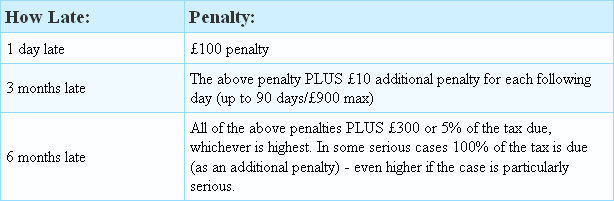
TODAY is the deadline for submission of your tax return. Contact Taxfile for help filing & avoid a minimum £100 fine!

31st January was the Self Assessment Tax Return Deadline!

Today (31 January) is the self-assessment tax return deadline!

[As at 1 February 2023]: The 31st January was the Self Assessment tax return and tax payment deadline. Miss the deadline and you’ll be in for a £100 HMRC fine right away. Interest will also be charged from 1 February, as usual, if tax is not paid by midnight on 31 January (rules apply). Time is short, so contact Taxfile for help with your tax return as soon as possible please. Book an appointment* with one of our helpful tax advisors and accountancy experts TODAY — we’ll make it easy!

020 8761 8000 Book Appointment Get Started Here
Read more

New Taxfile Brochure - Download Here

New Taxfile Brochure – Download Here

New Taxfile Brochure - Download Here.

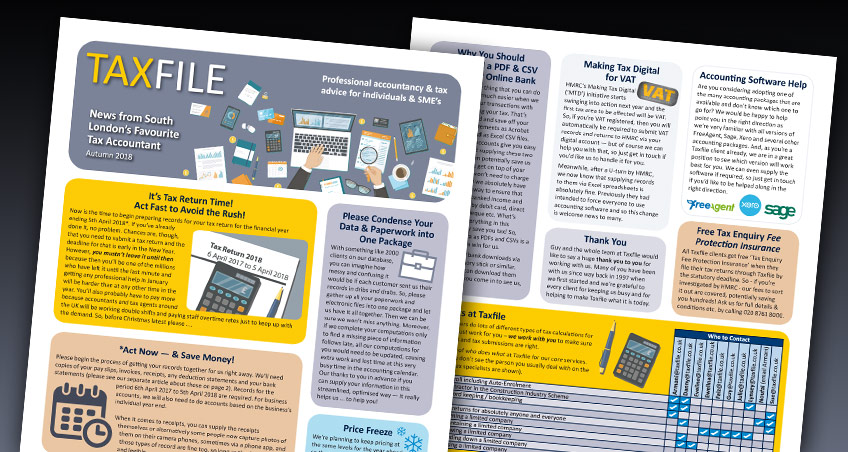
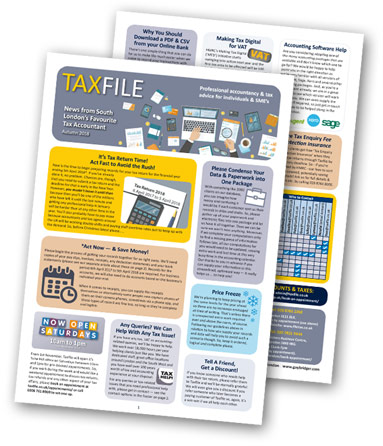
The new Taxfile brochure is out and you can download it here. Even if you’re an existing client, it’s worth taking a look in case we can help you in ways you weren’t aware of. We can help anyone e.g. the self-employed, directors of limited companies, partners in partnerships, sole traders, retired people, landlords, taxi and cab drivers, construction workers and just about anyone.

The new brochure covers:

  • Self-assessment income tax returns;
  • Services for SMBs;The new brochure from Taxfile - accountants and tax advisers in Tulse Hill, Dulwich, South London & the South West.
  • Accounts work for limited companies;
  • Bookkeeping and bank reconciliation;
  • Payroll & PAYE tax and National Insurance, company pensions and more;
  • VAT help, including for VAT schemes, registration and VAT returns;
  • Company pensions (auto-enrolment etc.);
  • Corporation Tax returns;
  • Confirmation Statements;
  • Making Tax Digital (MTD);
  • CIS calculations and tax rebates for construction workers;
  • Help with tax complications;
  • Taxfile brochure - inside spread.Dealing with HMRC on your behalf;
  • Joining or leaving various tax schemes;
  • Capital Gains Tax (CGT) calculations and handling;
  • Tax calculations relating to property income for landlords;
  • Disclosures of income not previously taxed (e.g. from abroad);
  • And much more.

Forward to a Friend – Free Consultation

Please feel free to forward the new Taxfile brochure to a friend who could benefit from our accountancy and tax-related services. We offer a free 20-minute consultation for new clients, without obligation.

020 8761 8000 Book Appointment Download Brochure

We are open 6 days a week during February including Saturday mornings (by appointment) and later opening (until 6pm) on Mondays and Tuesdays.

HMRC Waives Late Filing & Payment Penalty for 31st January Deadline

HMRC has taken the decision to not issue a late filing penalty for anyone who does not submit their self-assessment tax return before midnight on 31st January 2022.  It is important to point out that the deadline for filing your 2020-21 tax return remains 31/01/22 but the waiving of the penalty allows anyone who is unable to file their self-assessment tax return by the 31/01/22 deadline avoid a £100 late filing penalty as long as they submit their tax return  sometime before midnight 28th February 2022.

Furthermore, anyone that is unable to pay their self-assessment tax liability before 31st January 2022 will not receive a late payment penalty if they pay their tax in full, or call HMRC to arrange a payment plan before 1st April 2022.  It is important to note that interest will be added on taxes owed from 1st February 2022.

For a second year in a row, due to COVID, an extra Read more

Taxfile's Autumn Newsletter 2021

Taxfile’s Autumn Newsletter 2021

Taxfile's Autumn Newsletter 2021

Our tax and accountancy-related newsletter is available as a PDF download tooWelcome to Taxfile’s Autumn Newsletter for 2021. One of our biggest yet, it includes useful tax- and accountancy-related news that you need to be aware of, ways to save time or money – and much more. Take a look!

QR Codes

QR codes are quick links you can scan on your mobile phoneYou’ll find QR codes throughout the newsletter. These are a quick and easy way to access further information about the topic. Assuming you are viewing the newsletter on a desktop device or a printed* version, simply point your mobile camera phone at a QR code and then open the link that pops up. Your mobile’s browser will then take you straight to the information page. Alternatively, we supply simple link URLs to simply tap in.

Acrobat PDF version availableDownload As an Acrobat PDF & Print Out

* If you’re viewing on a small screen, it may be easier to read if you download the newsletter as an Acrobat PDF so you can print it out at full size (A4). Read more

New 30-Day Rules for Capital Gains on Residential Property

New 30-Day Rules for Capital Gains on Residential Property

New 30-Day Rules for Capital Gains on Residential Property

New rules have now come into force in relation to capital gains made on disposals of UK residential property*. Several key actions are now required if a taxable capital gain has arisen, including some that now need to be made fast:

  1. Taxpayers need to report the property’s disposal within 30 days of the actual disposal;
  2. They will need to pay the estimated Capital Gains Tax (‘CGT’) to HMRC within 30 days of the disposal.
  3. Those who fill in and submit a Self-Assessment tax return will also need to include details of the disposal on their return.

Who Do the New CGT Rules Apply To?

The new rules apply whether you’re an individual, joint property owner, trustee, partner in a partnership or LLP, or a personal representative.

What Counts as a Residential Property Disposal?

The new rules apply to all UK residential property that was disposed of (taken as the date of the exchange of contracts) since 6 April 2020 inclusive, where a capital gain was made that will require payment of CGT.

To fall within the rules, a UK residential property must be one that:

  • is suitable for use as a dwelling, or;
  • is being built or adapted for use as a dwelling.

It can be one in which the the owner has never lived or has lived for only part of the period they owned it. It can also be a rental property or a holiday home.

Where a property has been used for mixed purposes, only the capital gain that’s equivalent to Read more

How we harness technology at Taxfile in Tulse Hill, Dulwich, Devon & Cornwall

Harnessing Technology at Taxfile

How we harness technology at Taxfile in Tulse Hill & Dulwich, South East London

The rapid pace of technological change has caused some of the biggest shifts in how we view and process our tax returns. At Taxfile, we’re constantly striving to use technology as effectively as possible to aid us in collecting, analysing, and collaborating when working on your personal data.

Over the pandemic, we’ve had to place our reliance even further on technology to maintain our standards, with regular meetings online. We’re constantly improving the efficiency of our work pipeline and, with the ability to pull figures directly from online bank statements, we can ensure precision in the numbers we present you with. For the last two years, we’ve implemented cloud technology as both a collaborative tool between our senior and junior staff and as storage for various databases used to track everything from employee working hours to the status of your tax return. We’re expanding further on this concept in collaboration with Pure Technology by merging our existing cloud systems with our current remote work solution to form one, all-encompassing workspace environment. Hosting it in the Microsoft Cloud ensures that, with the help of our office staff, your paperwork and bookings can be sent to and viewed by your tax agent as soon as possible. This and a variety of other endeavours are examples of our ambitions to be at the forefront of innovations, and constant review of our policies ensures we remain ahead, or on track, to meet the standards set by Making Tax Digital (MTD) for its 2023 launch.

Contact South London’s Favourite Accountant

Taxfile can help you with all your tax or accountancy requirements. We offer Read more

PAYE, 2021/22 Tax Thresholds, Employment Allowance & P800s

PAYE, 2021/22 Tax Thresholds, Employment Allowance & P800s

PAYE, 2021/22 Tax Thresholds, Employment Allowance & P800s

My name is Daniel and I have been a part of the Taxfile family since 2007. It started as a part-time job doing bookkeeping, but as time went on, I developed new abilities and a deeper understanding of the tax world. PAYE, VAT, and Company Register are now my areas of expertise.

I understand how complicated the tax world is, so here are a few PAYE things to consider:

Understanding the tax thresholds for 2021-2022

PAYE is calculated based on how much you earn and whether you are eligible for the personal allowance.

  • Standard Rate: PAYE income tax is charged at 20%, less a personal allowance of £12,570, this is signified by tax code 1257L.
  • Higher Rate: For most, income over £50,270 to £150,000 is charged at 40%.
  • Additional Rate: Income above £150,000 is charged at 45%.

What is the Employment Allowance?

The Employment Allowance allows certain businesses that employ workers to reduce their annual National Insurance (NI) bill by up to £4,000 (for the 2021/22 tax year).
Eligible businesses can claim a reduction against their employer’s Class 1 NI liability up to a maximum of £4,000 each tax year. You can still claim the allowance if the liability was less than £4,000 in a tax year.

You can’t claim if you’re a company with only one employee paid above the Class 1 National Insurance Secondary Threshold (£8,840 for the 2021/22 tax year, up from £8,788 for the 2020/21 tax year) if that employee is also a director of the company.

How will I know if I haven’t paid the right amount of PAYE?

HMRC will send out a P800 tax calculation form after the tax year ends on 5 April, which you should receive by the end of November. This will show how much tax is due to be refunded, or is owed for previous years.

Another significant aspect of Taxfile is that it works with a wide range of accounts software (Sage, QuickBooks, Xero, FreeAgent, VT, Forbes, Moneysoft, and so on) and can accommodate everyone. These are just a few examples, but if you need assistance with any area of PAYE, VAT, or other types of tax, Taxfile and the team are here to help. Call Taxfile on 020 8761 8000, book a free appointment (in-person and phone or video call options are available) or simply message us your tax-related query and we’ll be happy to help. We are accountants and tax experts in South London.

This post was brought to you by Daniel at Taxfile.