Posts

First SEISS Grant Application Deadline Day Looms

First SEISS Grant Application Deadline Day Looms

Back in April, as a result of the Coronavirus pandemic, the Government announced the Self Employment Income Support Scheme (‘SEISS’), a taxable grant to support self-employed individuals and businesses affected by COVID-19.

The deadline for claiming this initial grant has been set as Monday 13 July 2020.

After this date you will no longer be able to claim for this first SEISS grant.

The 1st SEISS grant covered a 3 month period, for loss of income due to COVID-19, from April to June 2020. If you are eligible for this grant, you only have until Monday 13th July 2020 to make the claim. After this date the applications will close and you will have no means of applying.

Need Help?

If you have been putting it off, have not checked your eligibility status, or are unsure how to do so, then please call Taxfile on 020 8761 8000, and we can help you. Alternatively, fill in and submit the form below and we’ll be in touch.

(Interested in the 2nd SEISS grant? Click here).

    First Name (required):

    Surname (required):

    Email Address (required):

    Telephone Number (required):

    Your Message (please edit as you see fit):

    How did you discover this website today e.g. via a Search engine? (Required)

    Please click the button below to submit the form.

    Tax Returns for Self-Employed Londoners - Special Offer

    Tax Returns for Self-Employed Londoners – Special Offer!

    Tax returns for self-employed Londoners - Special Offer!
    Are you self-employed? Are you late filing your 2018/19 Self-Assessment tax return? If so, now is the time to get Taxfile to sort it out for you.

    There are 4 important reasons why you should file your tax return now:

    1. Save money, with our special offer!

    For a very limited time, we are offering to do 2018-19 Self-Assessment tax returns for self-employed Londoners for just £199 + VAT (our usual pricing is from £277 + VAT). That’s a saving of nearly £94 including VAT.

    2. Stay eligible for Government Help during the lock-down

    Self-employed people who are struggling financially during the coronavirus lock-down may be eligible for financial help from the Government. This is in the form of their recently announced Self-Employed Income Support Scheme (‘SEISS’). However, to remain eligible, you must have filed your 2018/19 Self-Assessment tax return by 23 April. If you miss that deadline, you will no longer be eligible for that Government assistance.

    3. Avoid severe fines from HMRC for being so late

    The original deadline for submission of your 2018/19 Self-Assessment tax return was actually 31 January 2020. So, if you didn’t already file your tax return by that date, you already owe HMRC a fine of £100 minimum. That’s nothing, though, compared to the penalties they will start charging you after April. From 1 May, you will owe an additional £10 per day, every day from that date if you still haven’t filed your 2018/19 tax return. So, for example, after a week you’ll owe the original £100 plus an additional £70 as a minimum, or the £100 plus a further £140 after two weeks and so on. You may also be charged interest on top of all of that if you owed HMRC a tax payment on the original 31 January deadline and still haven’t paid it.

    4. You may be due a tax rebate

    Some self-employed people may be due a tax rebate. This depends upon your

    Over 400 tax returns submitted

    We Submitted Over 400 Tax Returns in January!

    Over 400 tax returns submitted

    Taxfile prepared and submitted more than 400 Self-Assessment tax returns for clients during January. That’s about a hundred a week and goes to show just how busy it gets for us during January, the busiest month in our accounting calendar.

    Did you submit your tax return on time?

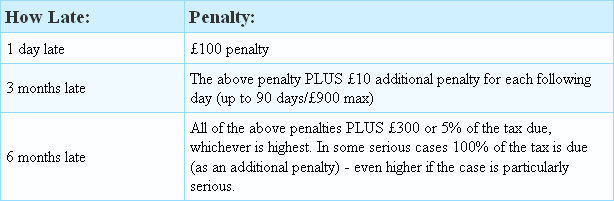
    The deadline for submission of your tax return (and payment of any tax due) was 31st January at midnight. Did you manage to submit yours in time? If not, you’re already into the ‘penalty’ period where HMRC basically fine you for being late. The penalty comes in the form of an initial £100 fine but that increases, potentially very significantly, as you get later and later with your tax return submission. If you look at the table below, it’s safe to say that you can end up owing a thousand pounds or more if you bury your head in the sand and are 3 months late, or more.  If you continue to leave your tax payment and tax return submission outstanding for six months or more, the penalty is £1300 as a minimum – perhaps more (it depends upon how much tax you owe).

    Late return penalties by HMRC

    Is your tax return & tax payment late? Taxfile can help!

    If you are late submitting your tax return or paying tax and don’t know how to straighten things out, don’t Read more

    Your Tax Return - All Wrapped Up for Christmas!

    Your Tax Return – All Wrapped Up for Christmas!

    Your Tax Return - All Wrapped Up for Christmas!

    Urgent: rather than waiting until January, start sorting out your Self-Assessment Tax Return out right now.

    Why now? Well, because every tax expert and accountant in the land is about to hit their busiest month in the accounting year — January. For tax professionals, January is a frantic time because everyone wants their tax matters sorted out at the same time due to HMRC’s deadlines. So, we have to take on extra staff, extend our opening hours and open at weekends — just to keep up with the demand. All of this costs extra money, so we have to increase charges a little during January to cater for the enormous increase in workload. January also becomes quite a bottleneck. In January alone, we are likely to have to prepare and submit around 500 Self-Assessment tax returns for our customers and that’s a very tall order.

    So — act now & save money on your tax return

    You can avoid extra charges by coming in to see us for your tax return now — well before January. It makes sense to come in early in November or December if you can. That way, we can have your tax affairs sorted in time for Christmas, avoiding the bottleneck. You can then relax in the knowledge that your tax matters have been sorted, ahead of the rush, at the best possible price.

    Saturday opening

    We’re open Saturday mornings at Tulse Hill from 9am until 1pm for a limited time. So, make the most of this opportunity and book a weekend appointment now, while it costs nothing extra.

    Get a tax refund for Christmas!

    We can help prepare and submit your Self-Assessment tax return and let you know the all-important amount of tax you need to pay or, indeed, may even be owed by HMRC. If you’ve overpaid tax, we could even get your refund for you in time for Christmas — what a Read more

    Making Tax Digital for VAT

    From 1st of April 2019 HMRC’s VAT Notice 700/22 will come into effect; Making Tax Digital (MTD) for Value Added Tax (VAT).  The MTD initiative is believed to benefit HMRC on two levels.

    It will help to ensure the correct VAT is being paid to HMRC, & seeing that VAT accounts for the highest unpaid tax in the UK (35%), the government has estimated that it will generate £610M in 2020-21 from eliminating erroneous returns.

    The MTD initiative will also save HMRC money as it will no longer have the cost associated with maintaining the VAT portal where submissions are currently made, estimating a saving of £10M a year of taxpayers’ money.

    HMRC’s long-term vision is to have one of the most digitally advanced tax administration systems in the world & they hope that by 2020 they will have MTD applied to all of UK’s taxation processes.

    For this vision to be fulfilled it is believed that they will then strive to have all taxation data recorded in the Standard Audit File for Tax (SAF-T) format.  Once this is achieved, HMRC will be able to undertake tax & VAT investigations frequently & randomly with very little cost, as it will free up resources from having to obtain & enter the data for analysis.

    Being VAT registered means that your annual income equals or exceeds the current threshold value of £85,000.00.  Currently, any business or individual registered for VAT, whether on a Flat Rate Scheme or on the Standard Rate, will from April 2019 need to prepare for the changes outlined by Notice 700/22.

    When will it be applicable to me?

    The 1st quarter of your VAT return that starts on, or after 1st April 2019.

    Am I exempt from MTD?

    Groups or individuals exempt from MTD include;

    • those with religious beliefs that prevent them from using technology
    • those going into insolvency
    • those that it is reasonably impractical to do so (eg. geolocation, physical &/or mental disabilities – that prevent the use of technology)

    What are my responsibilities?

    You will need to ensure that all your transactions (expenses & sales) are individually recorded digitally with a MTD-compliant software.  You still need physical &/or electronic copies of these records stored for at least 6 years.  The MTD-compliant software is then used to calculate & submit your VAT returns.

    What should my ‘digital’ data look like?

    From April 2019 all digital record keeping will include;

    • Business Name
    • Business Address
    • VAT Registration Number
    • VAT Account Schemes
    • Information about Supplies & Sales

    All Supplies & Sales invoices should include;

    • a Tax Point Date
    • Sequential (alpha-)numerical labelling format
    • Itemisation of services/goods
    • NET amount clearly shown
    • VAT rate & VAT amount clearly stated

    Currently, the date, NET & VAT amount all need to be digitally stored for each-and-every-one of your transactions.  It is also recommended that a digital upload of your bank feed is included to back the entries for both expenses & sales.  VAT will then be calculated using these digital entries & submitted to HMRC via the compliant software used to record them.

    View our latest MTDfVAT Newsletter HERE

    Christmas & New Year Opening Times at Taxfile

    Christmas & New Year Opening Times at Taxfile

    Christmas & New Year Opening Times at Taxfile

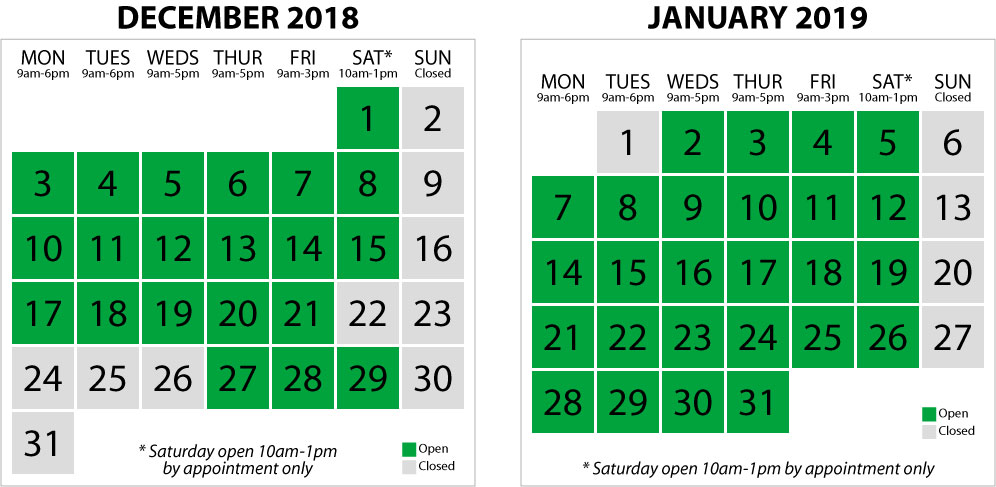
    Please take a look at the calendar above and note our opening times over Christmas and New Year. As you can see, we’re closed on several days over the festive period. This is particularly important for those who need to come to see us for help with time-sensitive accounting and tax-related services in the run-up to January 31st.

    Need Help Filing Your Tax Return?
    Make an Appointment NOW!

    In particular, we urge anyone who needs to file a 2017/18 Self-Assessment tax return to come and see us well before Christmas. By doing so, you’ll avoid the last minute stampede — way too many people leave it until January, which is the busiest time in the tax and accounting calendar. While the HMRC deadline for tax returns is the end of January, you run the risk of being caught up in the bottleneck if you leave things later than December. Taxfile files tax returns for thousands of customers during November, December and January, so we’re incredibly busy at this time of year — particularly January, which is frenetic! So, those leaving it until the last minute not only run the risk of being charged more to cover the long hours and overtime that we need to work during January, but they also risk receiving a fine from HMRC if they miss the deadline completely because they left things so late.

    So the message is: please book an appointment with us now, ideally for a date before Christmas.

    For Self-Assessment tax returns, records for the period 6th April 2017 to 5th April 2018 are required. For business accounts, we will also need to do accounts based upon the business’s individual year end.

    Open for Saturday Appointments

    We are happy to see people on Saturdays at this busy time of year (with the exception of the festive closures of course – see the calendar above). Saturday morning appointments should be more convenient for those who work on weekdays. As you can see on the calendar, we’re open from 10am to 1pm for most Saturdays in December and January but only for those with a pre-agreed appointment.

    To book an appointment, please call 0208 761 8000 or book an appointment online here. Many thanks.

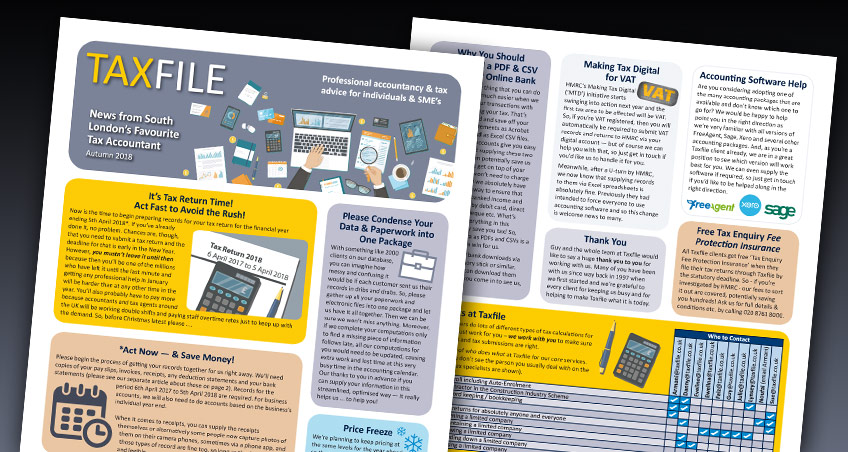
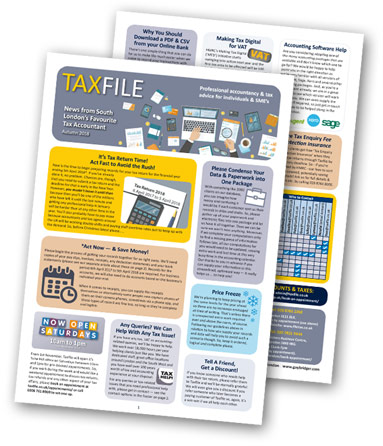
    Taxfile's Autumn Newsletter 2018

    Autumn Newsletter 2018

    Taxfile's Autumn Newsletter 2018

    Those of you who are not on our mailing list may be unaware of our latest newsletter. So, we thought we’d post a little about it here, along with a link where you can download an Acrobat PDF version to read at your leisure.

    Keep on Top of your Taxes

    The Autumn 2018 Newsletter is packed full of articles and advice to help you get on top of your taxes, make sure you are aware of the services we offer and, above all else, ensure that you file your tax return in good time.

    It’s Tax Return Time! Act Now!

    When it comes to Self-Assessment tax returns, the main message is to act now. That way you will avoid the January stampede and any unnecessary, additional expenses.

    Key Contacts at Taxfile

    Along with other tax news and advice, we also include a very useful table of your key contacts at Taxfile. Simply choose the service you require and the key people responsible for helping you can be found alongside, including their email addresses for direct contact.

    Download Taxfile's Autumn Newsletter 2018Download the eNewsletter

    To find out much more, download the Taxfile Autumn 2018 Newsletter here.

    Professional Help to Get Your Tax Affairs in Order

    Taxfile are super-keen to help you through the maze of HMRC rules and tax regulations. We’ll get your paperwork, accounts, bookkeeping and tax returns all in order. Simple!

    Open for Saturday Appointments

    Taxfile’s Tulse Hill (SE21) office is now open on Saturday mornings, from 10am until 1pm, for pre-booked appointments. So, if you’d like to discuss any aspect of your tax and a weekend appointment is more convenient than a weekday, call 0208 761 8000 to book one or book an appointment online here.

    Holiday lettings: tax guide for landlords with furnished lets in the UK/EU

    A Tax Guide for Landlords with Holiday Lets

    Holiday lettings: tax guide for landlords with furnished lets in the UK/EU

    Do you have a holiday cottage, flat or apartment that you rent out to holidaymakers? If so, our handy ‘Holiday lettings’ guide for landlords could be very useful to you — and it could save you money. It’s packed full of useful information and tax tips that will help you to make the most of your holiday property, at the same time as keeping on the right side of the tax man.

    The Pros

    We’ve written a section all about the tax breaks that apply to qualifying holiday lets. These include capital allowances for things you pay for when fitting out your holiday property, the tax treatment of expenses, the ability to pay pension contributions on your profits, several types of relief (some of which may affect your exposure to Capital Gains Tax) and small business rate relief.

    The Cons

    There’s also a section in the guide that covers some of the downsides to tax on holiday lettings. These include the need to get your VAT Registration status and charges right (where applicable) and also the tax treatment of any trading losses.

    Qualifying Conditions

    Lastly, there’s a section that outlines the qualifying conditions that apply if you want to treat your property as a holiday let rather than as an ordinary rental property. That’s important because different tax rules apply to each category and you could miss out on some excellent tax breaks if you don’t get it right. For example, the holiday rental property must be fully furnished and allow for self-catering holidays. Also, the property must be available for a particular number of days per year and be rented out in a particular way. It should not be occupied by the same tenant(s) for more than Read more

    Letting a room through Airbnb? HMRC tracks your income & data!

    Letting a Room through Airbnb? HMRC Tracks your Income!

    Letting a room through Airbnb? HMRC tracks your income & data!

    Back in late 2015, we forewarned that HMRC was planning to force on-line companies like Airbnb to share customer income data with them. That plan has come to fruition and HMRC is now receiving detailed information from Airbnb and other online providers. The data will tell HMRC about lettings income that may have been previously falling under their radar.

    Airbnb is an on-line marketplace where people can rent out rooms, cottages, apartments and suchlike to those looking for short-term accommodation, city breaks, holidays or lower cost alternatives to hotels and overnight business stays.

    We understand that various on-line providers, including Airbnb, are now exchanging information with HMRC. HMRC then uses their analytical tool “Connect” to track and monitor income from such sources. This powerful application was developed by BAE Systems and is the most advanced data gathering tool HMRC has at its disposal.

    So, if you let property or a room on Airbnb, you can expect detailed information to be passed to the Revenue about your letting activities and the income it generates. While you may currently be able to earn up to £7,500* per year tax-free for furnished accommodation under the Government’s ‘Rent a Room Scheme‘, care needs to be taken to submit a tax return and pay tax on any income received once you have gone over that limit. Higher rate taxpayers also need to take care if their rental income pushes them into a higher tax bracket.

    In order to qualify under the Rent a Room Scheme:

    • The room must be furnished;
    • The relief cannot be used if you let your home whilst living abroad;
    • The accommodation provided cannot be office space or business space.

    Changes arriving in 2019:

    HMRC recently held a consultation with relevant professionals and the public about whether the scheme should continue in its present form. Following this, they have announced that the scheme will be more restricted; landlords who do not live in their “main residence” at the same time as their tenants will probably no longer be able to claim “rent a room relief” from 6 April 2019.

    Tax Help & Advice for Lettings Income

    If you need our help handling your lettings tax needs, Taxfile is here to assist you. We’re tax experts and can guide you through the maze of rules and regulations concerning lettings, renting out accommodation, tax thresholds, knowing when it’s appropriate to work under the Rent a Room Scheme, whether you can claim expenses and so on. Book an appointment at your nearest Taxfile office: for Tulse Hill in London SE21 book an appointment on-line here; book here for Dulwich in SE21. Alternatively, simply call 0208 761 8000 or send us an email here and we’ll be happy to help to get you on the right track.

    Learn more about our services to landlords and those earning an income from property lettings here.

    * Correct for tax years 2016-17 and 2017-18. For tax year 2015-16 the threshold was only £4,250. Also note that the current year’s threshold reduces to £3,750 if someone else, for example a joint owner, receives lettings income in the same property.