
Posts

Autumn Newsletter 2016

Taxfile’s Autumn Newsletter 2016

Taxfile's Autumn Newsletter 2016

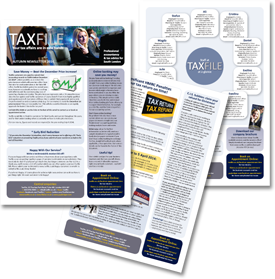
Taxfile's Autumn Newsletter 2016Hot off the press is our brand new Autumn newsletter for 2016. If you haven’t yet seen it, take a look because it’s jam-packed full of useful information that’ll help you keep your tax affairs and accounts in order, save you money and keep you up to speed on tax matters. Here’s a quick flavour of what’s included (or click the thumbnail image to view or download the newsletter):

  • Act fast to save money on your 2015-16 tax return – see the newsletter’s first article.
  • Sub-contractors working in the construction industry are invited to claim their CIS tax refunds through Taxfile, so they have their refund in time for Christmas!
  • Help if you’re late with any previous years’ tax returns and tax payments — and how you already owe HMRC at least £1300 if you haven’t filed your 2014/15 tax return or paid tax for that year.
  • Try the UK’s Number 1 cloud-based accounts package FREE, for a month. No credit card required – cancel at any time – full details are included in the newsletter. [UPDATE: Please note that this offer has now expired].
  • Help if your tax affairs are in a mess — are you late filing returns or paying tax? Are you worried about HMRC penalties? Are you a foreign worker, working in the UK, and need to get your tax records up to date following the Brexit decision? We’re here to help!
  • Taxfile are Finalists in the ‘Independent Firm of the Year, Greater London’ category of the British Accountancy Awards 2016.
  • Free tax enquiry Fee Protection Insurance for Taxfile customers who file their tax returns by the statutory deadline through Taxfile.
  • How online banking may save you time and money.
  • Introduce a new client to Taxfile and save 10% on our fees!
  • Saturday opening at Taxfile (Tulse Hill office) throughout November and December.
  • Help with all your tax and accounting needs – check out our list of all the things we can help you with — now including auto enrolment!
  • And a ‘thank you’ to all Taxfile customers … Read more
Email phishing scam or genuine HMRC communication?

Received an HMRC Tax Refund Email? It’s probably a Phishing Scam!

Email phishing scam or genuine HMRC communication?Several Taxfile customers have recently told us that they’ve been receiving emails, supposedly from HMRC, inviting them to click links within the emails in order to apply for tax refunds. Regrettably, some have confirmed that they did indeed click the links then log onto fake HMRC websites, which looked every bit real to them, thereby giving away such sensitive information as their bank details and things like their mother’s maiden name. Handing over such sensitive information to fraudsters would be an expensive mistake. In view of this, we thought we’d give our readers more information on what to look out for, what to expect to receive from HMRC, and what not to.

Firstly: How to Recognise a Scam Email

Here is an example of a real phishing (scam) email recently received by one of our customers. We’ve highlighted various areas of the email to indicate some of the telltale signs that the email is, indeed, a phishing attempt by fraudsters rather than a genuine communication from HMRC.

Example of a phishing email

Some of the many telltale signs that this email is fake include:

  • The sender is from a non-official domain (hmrcupdate.com is *not* a genuine HMRC website). Be careful, though, because some of the more advanced phishing emails do include genuine HMRC domains through what’s known as domain ‘spoofing’.
  • The recipient is not identified by name in either the ‘To’ field nor in the salutation (‘Dear Sir | Madam’ is a dead giveaway, as is the fact that the email was sent to ‘undisclosed recipients‘!). Genuine HMRC emails will always address you by the name you provided them.
  • Phishing emails often include silly errors that simply would not be published by the likes of HMRC. Under the logo, the date is wrong — it does not even mention a month!
  • The email states that you ‘are due some refunds‘ (plural). If HMRC did send emails announcing that a refund was available (and it doesn’t) then it would be singular, not plural! This is one of many hints that the sender has poor English (read on).
  • Press here‘ is another example of poor English. Of course, in the UK, we’d say ‘Click here’.
  • Povide us‘ is clearly spelt wrong — there should be an ‘r’ in ‘Provide’. Spelling errors are a common indication that the email is non-genuine and has instead come from overseas where English spelling and grammar are often not as accurate as they should be.
  • Further down it says ‘for refund‘ whereas it should say ‘for the refund’. Poor English/grammar again and another hint that this is a scam.
  • When you hover over the link included in the email (*without* clicking it), if your email application’s “status bar” is showing at the bottom of the screen, you can see where the link is pointing to. In this case it’s pointing to a goo.gl domain and this simply wouldn’t be the case if this was a genuine HMRC email.
  • Lastly, the email states that you have only 5 days to action the request. That is yet another telltale sign that this is a phishing scam. Fraudsters try to panic you into acting whereas HMRC would not make such a statement in a genuine email.

So you can see, when you look very carefully, that this is clearly a scam email. However, we should warn readers that other phishing emails are not so obvious. In fact, we’ve seen some real improvements in scam emails in recent months. One recent email was so genuine-looking that we’re not even 100% sure ourselves whether it’s a scam or not.

So what do you do if you are still not sure if an email is genuine?

If, after close scrutiny, you are still not sure whether the email is genuine, there are several things you can do … Read more

Guy Bridger outside the Tax Office

“Pay As You Go” Self-Assessment is on it’s way!

Pay-as-you-go Self AssessmentA few years ago Guy Bridger, from Taxfile, was helping to advise The Office of Tax Simplification and the then Director Michael Jack. Guy proposed that, while the bulk of the working population have their taxes calculated by their employer and thereforGuy Meets Rt. Hon Michael Jacke pay taxes in ‘real time’ with clarity, ease and convenience, the same was unfortunately not true for the UK’s small business owners and the self-employed. For those, it is too often the case that taxes are paid as much as 18 months in arrears because of limitations in the existing tax system. This time lag often means that the tax due to be paid has been spent already, simply because that old system had too large a reporting and payment window. So Guy suggested that ‘real time’ reporting and payments of tax would be significantly more convenient and beneficial to the small business owner and self-employed individual. It would enable them to keep on top of taxes and, as an added bonus, their accounts records too.

The Government has now recognised this good advice. In a new system nicknamed ‘Pay As You Go Self-Assessment’, the Chancellor has announced that small businesses, landlords and self-employed workers making more than £10k in profit each year will be able to account for tax in virtually “real time”. This will be made possible via Read more

Tax Credit Cuts Blocked by the House of Lords

House of Lords vs The Chancellor

In an almost unprecedented move, the House of Lords has backed a motion asking the government to revise its proposed tax credit cuts. This is the first time in 100 years that the lords have voted down a financial package and this is an embarrassing blow to George Osborne. The Chancellor has been asked to delay his proposed tax cuts until he comes up with a way of compensating low paid workers over the course of the first three years.

At present 9 in every 10 households receive tax credits but under the Chancellor’s new proposals this would reduce to 5 out of every 10 from April 2016. This means 3 million working families would lose, on average, about £1000 if the proposed changes go through next April.

Working Tax Credit & Child Tax Credit

There are 2 types of credit; Working Tax Credit and Child Tax Credit. Under the Chancellor’s new proposals Read more

Landlords warned over tax on Income from lettings & property investments

Buy-to-let Changes Are Coming — Landlords Beware

Landlords warned over tax on Income from lettings & property investmentsA warning and reminder to landlords: the Chancellor’s Summer budget back in July will hit buy-to-let investors’ profits once the changes kick in, so now is the time to start planning ahead. Not all landlords will be affected though; if their rental property is mortgage free or if they sell within the next 2 years these changes won’t affect them. However those landlords that are Higher and Additional taxpayers will notice their tax relief reduce by 2020. Also, investors near the tax threshold could find themselves in the next tax bracket, which could have a knock-on effect and increase their tax exposure.

So what are the proposed tax changes?

There are basically two:

  1. Firstly, the amount of tax relief landlords can claim on their mortgage interest will now be capped at basic rate and;
  2. Secondly, landlords will no longer be able to subtract their mortgage interest from their rental income before they calculate their taxable profit.

One in five landlords are expected to have to pay more tax because of these changes, however the new rules will not be phased in until between 2017 and 2021 according to the latest information.

What steps can landlords take?

There are several steps that investors can take to conserve as much profit as possible and to limit the amount of any extra tax payable. For example: Read more

Received a ‘P800 tax calculation’ from HRMC in the post?

If you have paid either too much or too little tax during the financial year, HMRC will send you a ‘P800 Tax Calculation’ some time between now and October 2015.

If you’ve paid too much tax

If you’ve paid too much tax then you will receive a cheque for the overpayment within 2 weeks of the P800 being issued.

If you’ve paid too little tax

If you’ve paid too little then the P800 will explain how much you owe and how HMRC intend to collect it. Usually this will be by adjusting your tax code so that the tax is recouped via future tax on earnings, however exceptions to this would include, for example, a situation where the taxpayer is now unemployed, in which case HMRC would explain alternative options for paying the money due. Read more

Tax Return 2014

STILL haven’t filed your tax return? You owe £410 in fines & counting!

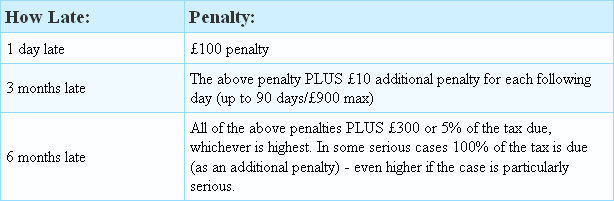
If you STILL haven’t filed your tax return despite the end of May being almost upon us, you’ll owe £410 in HMRC penalties by the end of this week. Continue to throw money down the drain at the rate of £10 extra per day thereafter if you still don’t submit your return.

As we explained in our last post, missing the original January 31 deadline meant an automatic HMRC penalty of £100 (on top of tax owed, of course) at that time.
But, with the additional penalty of £10 per extra day extra having been piling up since 1st May, it means you’ll need to add £310 to the original £100 penalty by the end of this week. Carry on like this for yet another month and by the end of June you’ll owe a whopping £710. It doesn’t end there — by the end of July it’ll be worse still as there is an additional £300 penalty levied by HMRC. Yes, that’s on top of the daily £10 fine and the original £100 penalty, meaning that the total penalty will then be £1300 as a bare minimum (it can be worse still if HMRC deem your case to be particularly serious). All this simply because your tax return is late.

All these penalties are in addition to the actual tax you owe!

Don’t forget … even if you owe no tax, you still need to submit your tax return so aren’t immune to the penalties. Take another look at the full post for more detail or, better still, contact us here at Taxfile urgently if you’d like our professional help in filing your tax return on your behalf — and minimising the penalties you’ll need to pay to HMRC. Call 0208 761 8000, click here to contact us or book an appointment with one of our tax advisors here and we’d be delighted to help. We are based in Tulse Hill, South London.

Tax Return 2014

Still Haven’t Filed Your Tax Return? Expect a Nasty Bill from HMRC!

Tax Return 2014If you still haven’t filed your tax return for the financial year up to 5 April 2014 you can expect the penalties from HMRC to begin racking up daily — and potentially very significantly — starting from Friday 1 May.

If you missed the 31 January Tax Return deadline …

If you missed the 31 January 2015 deadline for tax returns, you already owe HMRC £100 in fines on top of any tax you owe. If you don’t owe any tax whatsoever, HMRC still require a tax return from you, plus that £100 in penalties.

If you still haven’t filed your return by 1 May …

From 1 May 2015 you can also expect a £10 daily penalty to kick in, on top of the £100 fine above, up to a maximum addition for the period of £900 (90 days) extra. But it gets even worse…

If you STILL haven’t filed your return by 30 July …

After the 90 day period beginning on May 1st, if you STILL haven’t filed your tax return you’ll receive a further £300 penalty (or 5% of the tax due; whichever is highest) plus a possible additional fine equivalent to 100% (or more) of the tax due, depending on how serious the case is.

Each of these individual penalties is in addition to the preceding ones.

So, to conclude, if by 30 July 2015 you STILL haven’t filed your latest tax return you will be in for a minimum penalty of an incredible £1300.00 and that’s in addition to the tax you owe. Also, Read more

CIS - tax refunds for construction workers

Construction Industry Scheme (CIS): How to Claim a Tax Refund

CIS - tax refunds for construction workersIt’s now time to start the process of claiming your tax refund if you are a subcontractor working within the construction industry and have been paying tax, in advance, through the Construction Industry Scheme (‘CIS’). In this article we will tell you how you qualify and how to claim your tax refund. First, though, a little bit of background to the scheme:

The CIS Scheme

The Construction Industry Scheme, or CIS, is a scheme whereby a contractor in the construction industry usually deducts a proportion of the money due to their subcontractor, at source. The deducted amount is then passed direct to HMRC and counts towards the subcontractor’s tax and National Insurance, the tax element effectively being paid in advance. The exact proportion deducted depends on whether the subcontractor concerned has registered under the CIS system. If the subcontractor has not registered, the deduction will usually be made at a rate of 30%. If they have already registered, then the deduction will usually be made at a rate of 20%. Either way, by the financial year end, the amount of tax deducted at source will usually end up being more than they really needed to have paid, simply because it won’t have factored in the personal allowance which every UK taxpayer is entitled to (most UK citizens can earn up to £10,000 before paying tax at time of writing, this figure being set to rise to £10,600 in the tax year 2015-16, 10,800 a year later then increasing to £11,000 by 2017-18 following the recent budget proposals). Hence, many subcontractors in the construction industry will be due a tax refund because of the overpayment. The good news is that the time to apply for the refund is pretty much now, so get in touch if you’d like our help claiming.

What kind of work does CIS cover?

You qualify to be in the CIS system if you are a subcontractor who supplies construction work to buildings. This includes labouring, decorating, site preparation and refurbishment but excludes things like architecture, surveying services, the hire of scaffolding without labour, the fitting of carpets, the delivery of materials, and finally non-construction type services such as site facilities (canteens etc.).

What if your business is not in the UK?

Even if your business is abroad, the same rules apply if you work as a subcontractor within the UK. However there are some slightly different rules regarding the treatment of taxation for non-resident workers from countries which have ‘Double Taxation’ treaties with the UK (we can, of course, also help with that — just get in contact).

Registering for CIS

If you haven’t already registered for CIS as a sub-contractor, Taxfile can help to do this for you. You’ll need to be registered for Self Assessment (we can also help with this) and this will give you your UTR (unique taxpayer reference) number. We’ll also need your name, National Insurance number, your legal business/trading name and contact details. Once registered with CIS one of the immediate benefits will be that you’ll then have tax deductions made at the 20% rate rather than at 30%, which would otherwise be the case. If your business is a legal partnership you will also need to register it for CIS but this would need to be done in addition to being registered as an individual or sole trader. Of course, Taxfile can help with that too. Once you have been registered with CIS and have passed certain eligibility criteria, it is also possible to apply for ‘gross payment status’ meaning that you’ll then be paid by the contractor without the usual ‘at source’ deductions. Instead you’ll need to pay any outstanding tax and National Insurance at the financial year end; however HMRC will review your business each year to check that you still qualify for this status (paying tax late and/or submitting returns late would put your gross payment status at risk).

Offsetting Expenses against your tax

Taxfile can also help you to offset certain expenses against your subcontractor income. This means that any tax refund will be larger — or any tax outstanding will be lower. We can offset Read more

George Osborne

Highlights from the Chancellor’s Budget, 18 March 2015

Along with some encouraging news about the UK economy, some interesting new measures were announced in the Chancellor’s Budget yesterday and below we highlight those which we feel will directly impact the majority of UK taxpayers:

  • As widely forecast, the tax-free allowance will increase. The amount people can earn before paying tax will rise to £10,800 from 2016-17 and then to £11,000 from 2017-18. At the same points in time, higher earners will also receive a two stage increase to the threshold at which they start to pay a 40% rate of tax, with the threshold increasing to £43,300 by 2017-18.
  • The Chancellor also announced a brand new Personal Savings Allowance whereby the first £1,000 of interest (£500 for higher rate taxpayers) will be tax tree. This new allowance will kick in from April 2016 and will take 95% of taxpayers out of savings tax completely. (Fact Sheet available here).
  • Another new scheme announced was the introduction of a new ‘Help to Buy ISA’ aimed at prospective first time buyers. This fairly generous scheme means that the Government will chip in up to £50 extra per month (up to a ceiling of £3,000) when an eligible saver saves up to £200 per month towards their first home. (Fact Sheet available here).
  • In another ISA reform, savers will now be able to withdraw money from a new Flexible ISA and deposit it back later in the same financial year without losing any of their usual ISA tax benefits. £15,240 will be able to be put into this re-styled savings vehicle. Read more