Posts

Taxfile newsletter (Autumn 2015)

Save money & hassle with our latest PDF newsletter!

Taxfile newsletter (Autumn 2015)Check out our latest A4 newsletter — which is jam-packed with ways to save money when dealing with your tax affairs and is more comprehensive than our recent e-newsletter. Savings include our 5% Early Bird discount for help with your tax return or accounts before Christmas, our offer to reduce your Taxfile bill by a further 12½% if you introduce a friend who then becomes a Taxfile client, a shout out to all sub-contractors in the construction industry who, if they act fast, can have their CIS tax refunds in time for Christmas, plus Key Dates in the tax calendar, a warning to Landlords — and a whole lot more.

Download the newsletter here (Acrobat PDF format – right-click to save the PDF to your hard drive then open it in Acrobat Reader or alternatively left-click the link to view the newsletter directly in most browsers).

Beat The January Rush and Save!

Beat The January Rush and Save 5%TaxFile are offering a 5% reduction for clients who can submit their accounts to us before December 21st this year. This helps both of us — you receive a 5% reduction in your bill and it eases the rush in the New Year, our busiest time.

For example you could use this opportunity to reduce our charges for help with your self-assessment tax return submission if you’re self-employed, or for help with your CIS tax refund application if you’re a sub-contractor working in the construction industry, or if you’re one of our many clients who simply require tax advice and accountancy-related assistance from time to time.

Don’t delay – this discount is only available for a few weeks so call us on 020 8761 8000 or call into our Tulse Hill branch in SE21 for a chat and we’ll be delighted to help. You can also email us by clicking here or alternatively you can make an appointment with one of our tax agents here.

Taxfile Newsletter November 2015

Want to save money before Christmas?

Tax Newsletter

Taxfile tax newsletter November 2015Check out Taxfile’s latest e-newsletter to find out our latest tax news and easy ways you can save money — but only if you act fast.

Taxfile’s friendly staff are always available to help on all matters regarding tax and if you come in before 21st December we’ll give you a discount – check out the e-newsletter for full details and other ways to save even more. Up to date bulletins can also be found here on our tax blog.

If you’d like to save money on your self-assessment or tax refund, including CIS refunds for sub-contractors, call into Taxfile’s Tulse Hill Branch in SE21, or telephone 020 8761 8000.  You can also contact Taxfile online here or book a free introductory appointment with a tax advisor here.

If you’d like to be included in our future e-newsletter mail-outs, please click here. We only send a few each year and you can unsubscribe at any time with a simple mouse-click. Your details will, of course, not be passed on to anyone else — they are only used to send out our own newsletters and tax news.

Tax Credit Cuts Blocked by the House of Lords

House of Lords vs The Chancellor

In an almost unprecedented move, the House of Lords has backed a motion asking the government to revise its proposed tax credit cuts. This is the first time in 100 years that the lords have voted down a financial package and this is an embarrassing blow to George Osborne. The Chancellor has been asked to delay his proposed tax cuts until he comes up with a way of compensating low paid workers over the course of the first three years.

At present 9 in every 10 households receive tax credits but under the Chancellor’s new proposals this would reduce to 5 out of every 10 from April 2016. This means 3 million working families would lose, on average, about £1000 if the proposed changes go through next April.

Working Tax Credit & Child Tax Credit

There are 2 types of credit; Working Tax Credit and Child Tax Credit. Under the Chancellor’s new proposals Read more

Airbnb in HMRC crack-down on hidden income from renting out rooms

Hosts renting out rooms to be targeted by HMRC

Airbnb in HMRC crack-down on hidden income from renting out roomsHosts who rent out a spare room could soon see themselves being straddled with an unexpected tax bill if companies like ‘Airbnb’ are forced to share data with UK authorities.

Airbnb, the website that allows you to list, find or rent a room in a private residence, has announced that it now has to share details of its users’ rental profits with the tax authorities in Ireland. Airbnb was already required to share this information in America but, until now, has not been required to do so in the UK. However, HMRC are cracking down on unpaid tax from hidden income and this may result in companies like Airbnb soon having to share details of income earned by its UK customers.

Airbnb, which has headquarters in Ireland and America, say they are not currently governed by the same legalities in the UK and so will not be reporting income automatically in the UK but, as part of its crack-down on unpaid taxes, HMRC has said it will be approaching intermediaries like Airbnb for data on their clients. Read more

Received a ‘P800 tax calculation’ from HRMC in the post?

If you have paid either too much or too little tax during the financial year, HMRC will send you a ‘P800 Tax Calculation’ some time between now and October 2015.

If you’ve paid too much tax

If you’ve paid too much tax then you will receive a cheque for the overpayment within 2 weeks of the P800 being issued.

If you’ve paid too little tax

If you’ve paid too little then the P800 will explain how much you owe and how HMRC intend to collect it. Usually this will be by adjusting your tax code so that the tax is recouped via future tax on earnings, however exceptions to this would include, for example, a situation where the taxpayer is now unemployed, in which case HMRC would explain alternative options for paying the money due. Read more

George Osborne

Summer Budget 2015 – Key Tax Takeaways

The Summer Budget was announced last week and in this blog post we’ll take a look at only those changes which will affect ordinary taxpayers and SMEs.

In his opening remarks, the Chancellor of the Exchequer, George Osborne, promised:

A Budget … to keep moving us from a low wage, high tax, high welfare economy; to the higher wage, lower tax, lower welfare country.

So, taking each of those goals in turn …

Higher Minimum Wages

With regard to the higher wages promise, Osborne announced that there would be a new National Living Wage of £7.20 per hour from April 2016 for those aged over 25 and over, rising to more than £9 per hour by the year 2020.

Lower Tax

With regard to the lower tax promise, the Personal Allowance (the amount people can earn before paying any tax) will increase – as anticipated – from £10,600 in the financial year 2015-16 to £11,000 in 2016-17. A longer term plan is to increase this still further to £12,500 by 2020. The ultimate ambition is pass a law to make sure that those working 30 hours a week and earning the National Minimum Wage will pay no tax whatsoever, although clearly this will need further clarification in due course.

Dividend tax will also be reformed. Here the existing dividend tax credit (this reduces tax paid on dividends from shares) will be replaced by a new £5,000 tax-free allowance on income from shares from April 2016 and this will be available to all taxpayers. To offset the cost of this to the Exchequer, those with more significant dividend income will see an increase in the tax rate they pay.

Inheritance tax will also be subject to changes from 2017-18. The idea is to allow individuals to each have a ‘family home allowance’ which they can pass on to their children or grandchildren, tax-free, when they die. This allowance will be added to the existing Inheritance Tax threshold currently set at £325k and will potentially allow property up to the value of £1m to be passed down from 2020-21 (see table below). For those with estates valued over £2m the allowance will be gradually withdrawn.

This is how the effective Inheritance Tax thresholds will look in 2020-21: Read more

Tax advice

Case Study: a high rate taxpayer in a complex tax situation

The Client

A new client, Mr ‘K’,  is a higher rate taxpayer who previously used to file his own tax returns.

The Problem

Mr K got into a complicated financial situation in 2013/14 due to having received redundancy pay, severance pay waiver, investment income, PAYE income and pension income. He needed professional guidance and advice regarding his tax liability.

The Solution

Taxfile looked into all the records and correspondence regarding the redundancy and severance pay so as to make sure of the right tax treatment for each. We also calculated the various tax rates for each type of income and advised that the remaining tax liability should be collected through the tax code system.

The Result

The client was reassured that the tax calculation was done professionally and accurately and was able to pay the right amount of tax in the most appropriate way.

Client Feedback

The client was impressed with how quick and efficient Taxfile’s service was and, as a result, is continuing to use our service now and into the future. Read more

Tax Return 2014

STILL haven’t filed your tax return? You owe £410 in fines & counting!

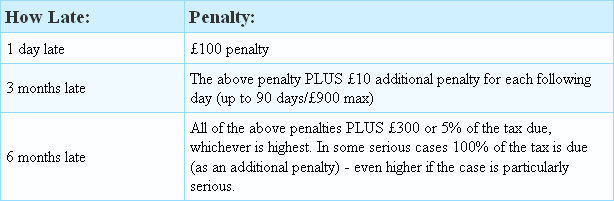
If you STILL haven’t filed your tax return despite the end of May being almost upon us, you’ll owe £410 in HMRC penalties by the end of this week. Continue to throw money down the drain at the rate of £10 extra per day thereafter if you still don’t submit your return.

As we explained in our last post, missing the original January 31 deadline meant an automatic HMRC penalty of £100 (on top of tax owed, of course) at that time.
But, with the additional penalty of £10 per extra day extra having been piling up since 1st May, it means you’ll need to add £310 to the original £100 penalty by the end of this week. Carry on like this for yet another month and by the end of June you’ll owe a whopping £710. It doesn’t end there — by the end of July it’ll be worse still as there is an additional £300 penalty levied by HMRC. Yes, that’s on top of the daily £10 fine and the original £100 penalty, meaning that the total penalty will then be £1300 as a bare minimum (it can be worse still if HMRC deem your case to be particularly serious). All this simply because your tax return is late.

All these penalties are in addition to the actual tax you owe!

Don’t forget … even if you owe no tax, you still need to submit your tax return so aren’t immune to the penalties. Take another look at the full post for more detail or, better still, contact us here at Taxfile urgently if you’d like our professional help in filing your tax return on your behalf — and minimising the penalties you’ll need to pay to HMRC. Call 0208 761 8000, click here to contact us or book an appointment with one of our tax advisors here and we’d be delighted to help. We are based in Tulse Hill, South London.

Tax Return 2014

Still Haven’t Filed Your Tax Return? Expect a Nasty Bill from HMRC!

Tax Return 2014If you still haven’t filed your tax return for the financial year up to 5 April 2014 you can expect the penalties from HMRC to begin racking up daily — and potentially very significantly — starting from Friday 1 May.


If you missed the 31 January Tax Return deadline …

If you missed the 31 January 2015 deadline for tax returns, you already owe HMRC £100 in fines on top of any tax you owe. If you don’t owe any tax whatsoever, HMRC still require a tax return from you, plus that £100 in penalties.

If you still haven’t filed your return by 1 May …

From 1 May 2015 you can also expect a £10 daily penalty to kick in, on top of the £100 fine above, up to a maximum addition for the period of £900 (90 days) extra. But it gets even worse…

If you STILL haven’t filed your return by 30 July …

After the 90 day period beginning on May 1st, if you STILL haven’t filed your tax return you’ll receive a further £300 penalty (or 5% of the tax due; whichever is highest) plus a possible additional fine equivalent to 100% (or more) of the tax due, depending on how serious the case is.

Each of these individual penalties is in addition to the preceding ones.

So, to conclude, if by 30 July 2015 you STILL haven’t filed your latest tax return you will be in for a minimum penalty of an incredible £1300.00 and that’s in addition to the tax you owe. Also, Read more