HMRC expects people to do tax returns for various reasons;
Those that have an income outside of a PAYE scheme (i.e. self-employed)
High earners on PAYE schemes, earning above £100K
Company Directors & Shareholders
Landlords who have rental incomes
The tax returns calculated generally run between the dates 06/04/xx through to 05/04/xy, the calculation, submission, and payment deadline of taxes owed to HMRC (or you), would need to be submitted at the latest 31/01/xz, before penalties & interest are imposed.
Each year, the Government announces a tax free allowance, which is the amount you can earn before your income starts to get taxed. The tax free allowance for 2018/19 is £11,850.00. However, this allowance decreases by £1 for every £2 earned above £100k, meaning by the time your reach £125K, the allowance is £0.
The amount of tax paid on income is also specified by the government & is subject to change with announcements made generally in the Budget statements. For 2018-19 the rates are as follows;
Tax Rate (Band)
Taxable Income
Tax Rate
Personal allowance
Up to £11,850
0%
Basic rate
£11,851 to £46,350
20%
Higher rate
£46,351 to £150,000
40%
Additional rate
Over £150,000
45%
*For 2019-20 the new rates & tax free allowance can be found HERE.
Since 6th April 2019, you would have been able to calculate & submit your 2018/19 tax return to HMRC, so since then the Tax Agents at Taxfile have been busy filing away for the early birds. We have been open on Saturdays too, to keep up with the influx of tax returns & CIS returns.
However, the last Saturday that we will be open will be 29th June. If you would like to join our ‘gang’ of Early Bird & can only come in on Saturdays, you only have a few weekends left.
Please note, on Saturdays, all our agents see clients by appointment only, and can not generally deal with walk-in clients. So please book in advance by either calling 020 8761 8000 or booking online HERE.
So get our professional help at Taxfile & we’ll make filling in and filing your tax return a breeze.
https://www.taxfile.co.uk/wp-content/uploads/2019/06/Early-bird.jpg650800Taxfilehttps://www.taxfile.co.uk/wp-content/uploads/2020/03/taxfile-logo-2020.pngTaxfile2019-06-07 11:31:552021-10-31 19:32:32The Early Bird Gang
Do you have a holiday cottage, flat or apartment that you rent out to holidaymakers? If so, our handy ‘Holiday lettings’ guide for landlords could be very useful to you — and it could save you money. It’s packed full of useful information and tax tips that will help you to make the most of your holiday property, at the same time as keeping on the right side of the tax man.
The Pros
We’ve written a section all about the tax breaks that apply to qualifying holiday lets. These include capital allowances for things you pay for when fitting out your holiday property, the tax treatment of expenses, the ability to pay pension contributions on your profits, several types of relief (some of which may affect your exposure to Capital Gains Tax) and small business rate relief.
The Cons
There’s also a section in the guide that covers some of the downsides to tax on holiday lettings. These include the need to get your VAT Registration status and charges right (where applicable) and also the tax treatment of any trading losses.
Qualifying Conditions
Lastly, there’s a section that outlines the qualifying conditions that apply if you want to treat your property as a holiday let rather than as an ordinary rental property. That’s important because different tax rules apply to each category and you could miss out on some excellent tax breaks if you don’t get it right. For example, the holiday rental property must be fully furnished and allow for self-catering holidays. Also, the property must be available for a particular number of days per year and be rented out in a particular way. It should not be occupied by the same tenant(s) for more than Read more
https://www.taxfile.co.uk/wp-content/uploads/2018/09/Furnished-holiday-lettings002.jpg5001500Markhttps://www.taxfile.co.uk/wp-content/uploads/2020/03/taxfile-logo-2020.pngMark2018-09-19 10:29:322025-03-13 15:16:53A Tax Guide for Landlords with Holiday Lets
Back in late 2015, we forewarned that HMRC was planning to force on-line companies like Airbnb to share customer income data with them. That plan has come to fruition and HMRC is now receiving detailed information from Airbnb and other online providers. The data will tell HMRC about lettings income that may have been previously falling under their radar.
Airbnb is an on-line marketplace where people can rent out rooms, cottages, apartments and suchlike to those looking for short-term accommodation, city breaks, holidays or lower cost alternatives to hotels and overnight business stays.
We understand that various on-line providers, including Airbnb, are now exchanging information with HMRC. HMRC then uses their analytical tool “Connect” to track and monitor income from such sources. This powerful application was developed by BAE Systems and is the most advanced data gathering tool HMRC has at its disposal.
So, if you let property or a room on Airbnb, you can expect detailed information to be passed to the Revenue about your letting activities and the income it generates. While you may currently be able to earn up to £7,500* per year tax-free for furnished accommodation under the Government’s ‘Rent a Room Scheme‘, care needs to be taken to submit a tax return and pay tax on any income received once you have gone over that limit. Higher rate taxpayers also need to take care if their rental income pushes them into a higher tax bracket.
In order to qualify under the Rent a Room Scheme:
The room must be furnished;
The relief cannot be used if you let your home whilst living abroad;
The accommodation provided cannot be office space or business space.
Changes arriving in 2019:
HMRC recently held a consultation with relevant professionals and the public about whether the scheme should continue in its present form. Following this, they have announced that the scheme will be more restricted; landlords who do not live in their “main residence” at the same time as their tenants will probably no longer be able to claim “rent a room relief” from 6 April 2019.
Tax Help & Advice for Lettings Income
If you need our help handling your lettings tax needs, Taxfile is here to assist you. We’re tax experts and can guide you through the maze of rules and regulations concerning lettings, renting out accommodation, tax thresholds, knowing when it’s appropriate to work under the Rent a Room Scheme, whether you can claim expenses and so on. Book an appointment at your nearest Taxfile office: for Tulse Hill in London SE21 book an appointment on-line here; book here for Dulwich in SE21. Alternatively, simply call 0208 761 8000 or send us an email here and we’ll be happy to help to get you on the right track.
* Correct for tax years 2016-17 and 2017-18. For tax year 2015-16 the threshold was only £4,250. Also note that the current year’s threshold reduces to £3,750 if someone else, for example a joint owner, receives lettings income in the same property.
https://www.taxfile.co.uk/wp-content/uploads/2018/07/Airbnb-tax-featured.jpg566848Markhttps://www.taxfile.co.uk/wp-content/uploads/2020/03/taxfile-logo-2020.pngMark2018-07-26 16:12:482025-03-13 14:45:09Letting a Room through Airbnb? HMRC Tracks your Income!
If you are a taxpayer with overseas assets which are undeclared as regards income tax, capital gains tax or inheritance tax, you have an obligation to sort things out by 30 September 2018.
People who ignore this requirement and whose income or assets subsequently come to light will face much, much higher penalties and sanctions after the deadline.
Why bother now?
The United Kingdom has signed up for information exchange with a whole host of other countries. The information it receives from them will be input into its intelligence system known as Connect. This increases the likelihood of undeclared sources coming to light.
What if I do nothing?
After the deadline date, if your undeclared sources of income or gains come to light, you will face potential penalties as follows:
A tax geared penalty of between 100% and 200% of the tax due;
A potential asset based penalty of up to 10% of the asset value where the relevant tax at stake is over £25,000 in any one tax year;
Adverse publicity from being publicly named as a tax cheat where the tax is over £25,000;
A further potential penalty of 50% of the standard penalty if the Revenue show that assets or funds have been moved in an attempt to avoid the requirement to correct.
If you have a reasonable excuse for failing to correct your tax position, such as failing health for example, then penalties may be reduced or not charged in exceptional circumstances.
Get Started:
If you think you might be affected or are in any doubt, we suggest you act now to avoid any problems before the deadline.
Call Taxfile on 0208 761 8000 for a no-obligation discussion if you want to put things right. Alternatively, book an appointment here. We have a wealth of experience in dealing with voluntary disclosures and negotiating settlements with HMRC, so can definitely help you. We offer tax advice and accountancy services from our offices in Tulse Hill and Dulwich in South London.
https://www.taxfile.co.uk/wp-content/uploads/2018/06/Overseas-assets.jpg477848Markhttps://www.taxfile.co.uk/wp-content/uploads/2020/03/taxfile-logo-2020.pngMark2018-06-28 09:15:342025-03-13 14:59:18Undeclared Overseas Assets? Beware the ‘Requirement to Correct’ Deadline!
Owners of second properties and let properties need to be aware that HMRC is planning to introduce new rules from 6 April 2020 to require payment of Capital Gains Tax much, much earlier! The window of payment will be reduced from 31 January following the year of the gain to a mere 30 days from the date of the sale.
Effectively, ‘in year’ reporting of the estimated gains – and payment of the tax – is mandatory under the new rules. Failure to report the gains and pay the tax will lead to penalties for landlords and second home owners.
You will only be able to offset losses accrued at the time of the disposal, so losses later in the year will not be available against the payment on account.
Summing Up:
If you make a capital gain in 2018/19 (before the new rules kick in) you will pay the capital gains tax on or by 31 January 2020.
For the sale of a house that is let, or a second property, with exchange of contracts occurring on, say, 15 April 2020 with completion happening on 15 May 2020, the Capital Gains Tax (CGT) has to be paid by 14 June 2020. This accelerates the payment of the tax to the Exchequer by 7 months.
So, perversely, the later year requires the Capital Gains Tax payment before the earlier year, as you can see above!
The other difficulty is knowing what rate to apply because a higher rate taxpayer has to pay 28% on a gain but a basic rate taxpayer has to pay tax at 18% up to the limit of the basic rate band that is unused. This is, of course, one situation where Taxfile can help to work out the tax implications for its customers. Tax calculations are what we do best and we’re here to help you!
Note that Scottish tax rates may vary.
HMRC is currently assessing feedback on their consultation, which closed on 6 June 2018.
If you believe this change of rules is wrong, one option is to write to your MP to complain.
Professional Help with Tax & Accountancy – for Landlords & More
For help with accountancy and tax for any property, lettings or any capital gains situation you may find yourself in, contact your nearest branch of Taxfile. We have London offices in Tulse Hill, and Dulwich, in London SE21. Call 0208 761 8000 for an introductory chat or appointment, contact us here or click the bold links for more information. We’ll be happy to help and to get your tax affairs in order.
https://www.taxfile.co.uk/wp-content/uploads/2018/06/Capital-gains-changes.jpg550848Markhttps://www.taxfile.co.uk/wp-content/uploads/2020/03/taxfile-logo-2020.pngMark2018-06-13 17:08:592025-03-13 15:04:54Second Property & Rented Property ‘Tax Trap’ for the Unwary
Taxfile has over 100 years of combined tax and accounting experience. It’s incredible to think that the key personnel have administered over 30,000 tax submissions in the past 20 years! Beginning way back in 1994 (and continuing as Guy Bridger Limited from 1997), we originally started business offering only CIS sub-contractor returns but quickly developed the service to help the self-employed, local businesses and higher rate taxpayers with their tax computations. Along the way we added tax and accounting services for taxi drivers, cab drivers, landlords and more. We also offer Capital Gains tax expertise and tax investigation help and, more recently, professional help with disclosures, written tax advice and tax planning for things like inheritance.
We have exceptional accounting experience in all key tax and accounting areas including:
and just about any other tax and accounting-related assistance you can think of.
Taxfile helps individuals as well as businesses. Our customers are very varied, turning over anything from £10,000 to over £1 million a year. A few are high wealth individuals who no longer need to work but still need to account for their taxes etc. Some customers have retired, others operate small businesses and some don’t even live in the UK but may have assets here. So, whatever your income, assets or situation, the message is that if you need ANY tax-related help, you’ve found the right place in Taxfile.
Taxfile also has the back-up and expertise of professional bodies on tap (so nothing is too complicated for us) and also has excellent relations with the tax authorities — we’re very well trusted by HMRC. Guy even helps in the local employment zone, which aims to improve business in the Tulse Hill and West Norwood area. So, Taxfile is very much part of the local community, particularly in South London (but expanding to other areas too — keep an eye on this blog for forthcoming information about that in the very near future).
Whatever help you need with tax and accountancy-related matters, call Taxfile on 0208 761 8000 and we’ll be delighted to help you. Alternatively, Read more
https://www.taxfile.co.uk/wp-content/uploads/2018/02/One-stop-tax-help-shop.png579614Markhttps://www.taxfile.co.uk/wp-content/uploads/2020/03/taxfile-logo-2020.pngMark2018-02-03 10:28:542025-03-13 15:18:07Taxfile: Your One-Stop Tax & Accountancy Shop
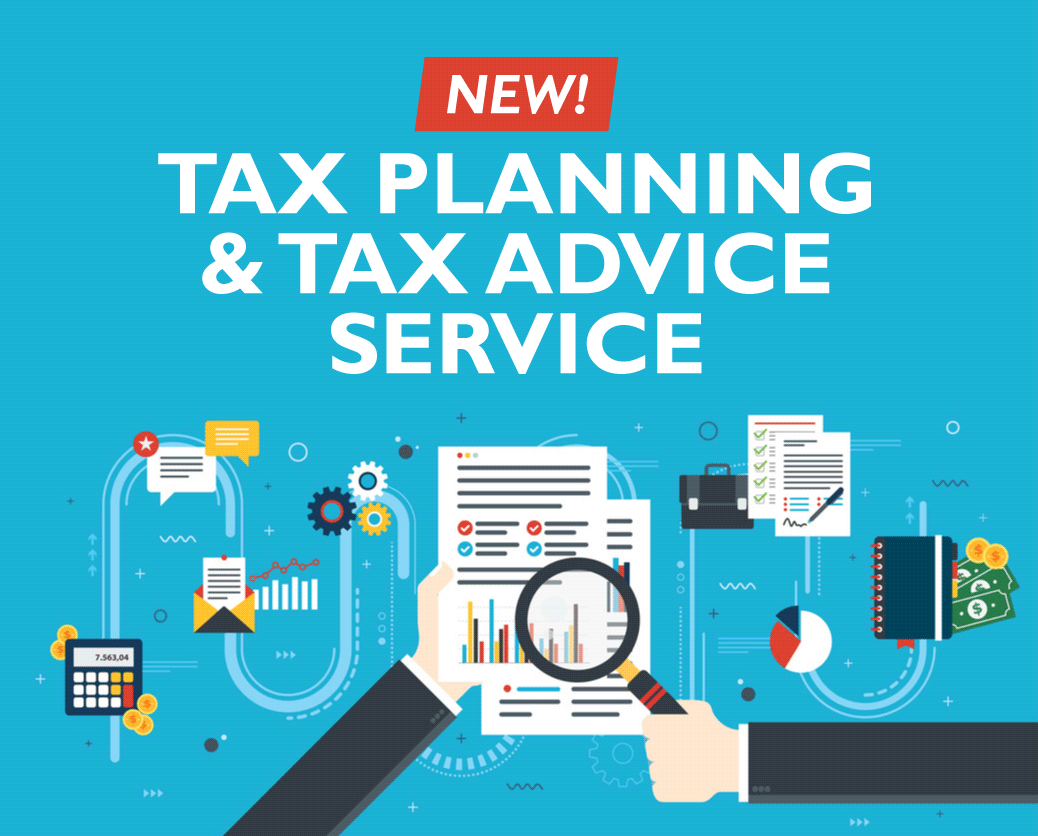
You can now get tax planning and tax advice from Taxfile. We have highly experienced senior accounting staff who can give you the right tax advice when you need it most — for example, when your circumstances are changing, if you’ve had trouble keeping on top of your tax commitments and need to bring things up to date, or perhaps a friend or relative simply needs a bit of reassurance with regard to their tax situation. Perhaps you have assets or income abroad as well as income in the UK and want to make sense of your tax position. Or, perhaps you have recently made a tidy profit trading crypto coins like Bitcoin and want to know where you are from the standpoint of Capital Gains or Income Tax. Maybe you need to disclose income from property rental that you have previously not told HMRC about (more about that in a later post). Those are all examples of typical situations where our new Professional Tax Advice and Tax Planning services can help you to see the wood from the trees.
A Free Telephone Consultation
In the first instance, we are inviting clients to speak for just 15 minutes with one of our resident tax planning experts. This will be in the form of a free, introductory telephone call, perhaps in February or March if it suits you. We can then see what’s needed and take it from there. We can, of course, discuss any costs with you before you commit to anything further, and there is no obligation.
Whether it’s about labour taxes, investment taxes, business taxes, disclosures to HMRC or even professional help to support you during an HMRC tax investigation, we can make sense of all the options for you and — in a fair and ethical way — help to make sure you are paying no more tax than you should do. With decades of experience in accountancy and tax planning, we know exactly what’s what when it comes to tax, so can definitely help you. Call 0208 761 8000 to arrange your free 15 minute telephone appointment with a tax expert, at a mutually convenient time. Alternatively, Read more
https://www.taxfile.co.uk/wp-content/uploads/2018/02/Tax-planning-advice-servi.png8361038Markhttps://www.taxfile.co.uk/wp-content/uploads/2020/03/taxfile-logo-2020.pngMark2018-02-02 12:55:242021-10-31 19:44:44New: Tax Advice & Planning Service
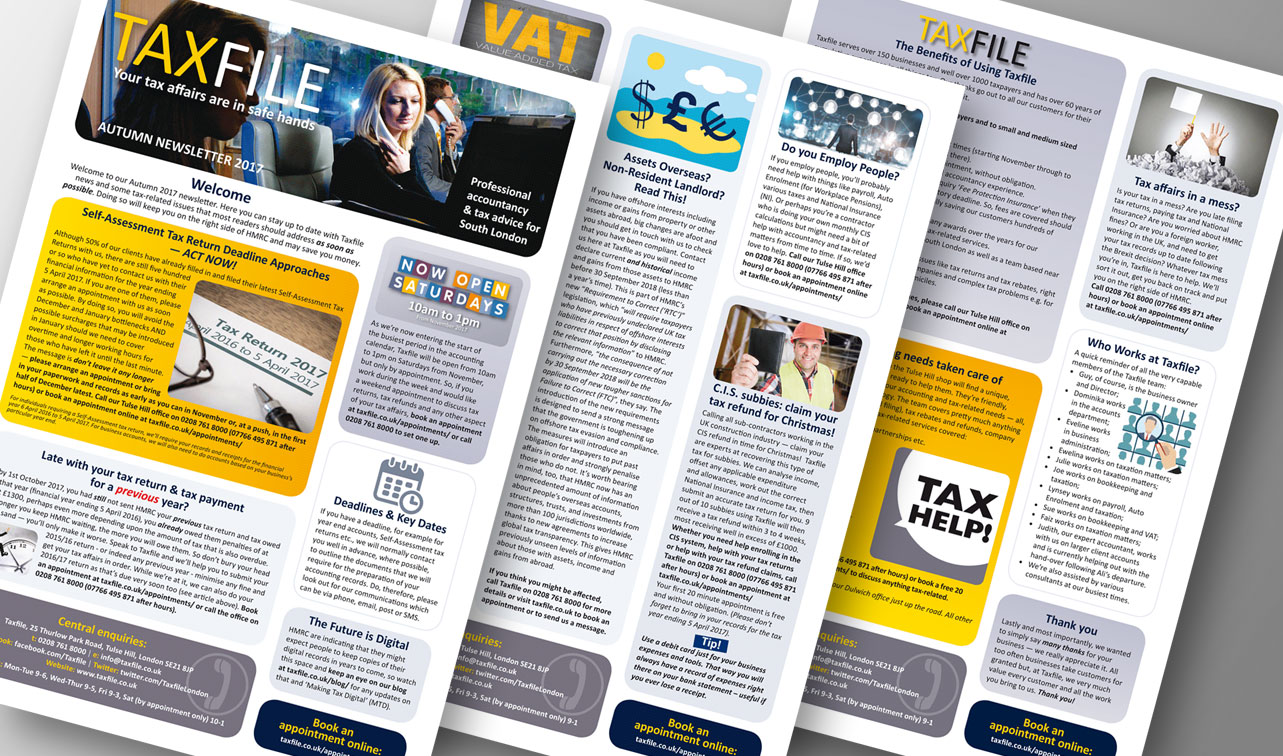
The Autumn 2017 edition of Taxfile’s newsletter is now out and it’s packed full of useful information, tips, recommendations and key dates in the tax and accounting calendar, including some things you need to act on right away if you want to save time and money. Here is a quick overview of the articles:
This week, Chancellor of the Exchequer Philip Hammond delivered his Autumn Budget Statement to the House of Commons. View his full 1 hour speech in the official UK Parliament video below, which also includes a response from Jeremy Corbyn, leader of the opposition:
The biggest news from this budget was the Stamp Duty announcement, wherein first time buyers buying a property up to £300,000 in value will no longer pay Stamp Duty at all (saving £5k), nor pay it on the first £300,000 of homes costing up to £500,000. Money man Martin Lewis gave his take on the proposed Stamp Duty changes and answered frequently asked questions pertaining to exactly what defines a first time buyer in an interview on Good Morning Britain yesterday — here is a 5 minute clip:
Other winners included
The Personal Allowance, which is the amount people can earn before they need to start paying income tax, is set to increase by £350 from £11,500 to £11,850 for those earning up to £100k per annum.
The National Living Wage (NLW) will increase from £7.50 to £7.83 per hour from April 2018. This will affect UK workers aged over 25.
The Chancellor promised investment of £160m in 5G mobile networks …
… and a total of £550m for electric cars.
He also set aside an additional £1.5 billion in Universal Credit to help those on benefits.
£40m was set aside for a teacher training fund for under-performing schools in England.
NHS England is to receive £2.8BN in investment (less, though, than the £4BN NHS bosses said is needed).
From April 2018, the Consumer Price Index (CPI) is set to replace the Retail Price Index (RPI) as the inflation measure through which business rates will be calculated. It is anticipated that this change will save businesses £2.3BN in the first three years of the change.
The Chancellor also abolished the very unpopular staircase tax and promised that those affected to date by the staircase tax would see original rates reinstated. Revaluations will take place every three years (previously five) after the next scheduled revaluation in 2022.
Losers included:
The Chancellor revised down the growth forecasts for GDP, productivity growth and business investment.
£3BN was set aside for helping to combat Brexit challenges.
For second property owners, powers have been given to local authorities to charge a 100% council tax premium on empty houses. (See our note about those getting an income from property rental below).
If you have any questions about how the Autumn Budget might affect you, or any queries about any tax or accounting issues and requirements you may have, simply contact Taxfile on 0208 761 8000, send us a message here or book a 20 minute appointment online here and we’ll be happy to help. We also offer specific tax help and accounting for landlords so do get in touch if you would like to make sure you’re claiming no more and no less than you should if you’re getting an income from letting property.
Links to more detailed HMRC information about the Autumn Budget Statement can be read online here.
HMRC have been busy, behind the scenes, shaking things up with regard to the personal data they hold on UK taxpayers. They’ve been pulling in – rather successfully – personal data from various different government departments and bringing all that data into one central place for both them and us to see, whenever the need arises. This is all part of their longer-term plan for Making Tax Digital or ‘MTD’ as it’s known in the tax and accounting world. So, with that in mind, this is the first in a series of posts that introduces MTD and a crucial part of that; Personal Tax Accounts (PTAs). In this series of articles we’ll discuss what MTD will mean for most of us, we’ll look at the kinds of data that will be stored, see how it’ll affect us and, lastly, see if there is anything that we’ll need to do.
Personal Tax Accounts (PTAs)
One of the core elements of MTD is the Personal Tax Account (PTA). In years to come, each UK individual is likely to become very used to logging into their Personal Tax Account on the HMRC website. In fact, these already exist and most, if not all, UK taxpayers can already access them if they want to. When accessed, it’s quite interesting to see the huge amount of data already accessible via your own PTA if you care to take a look. You may be surprised just how much data they contain for you.
For those not yet ready to take the plunge, we’ve taken a look for you, as you’ll see. And, so far, we are quite impressed.
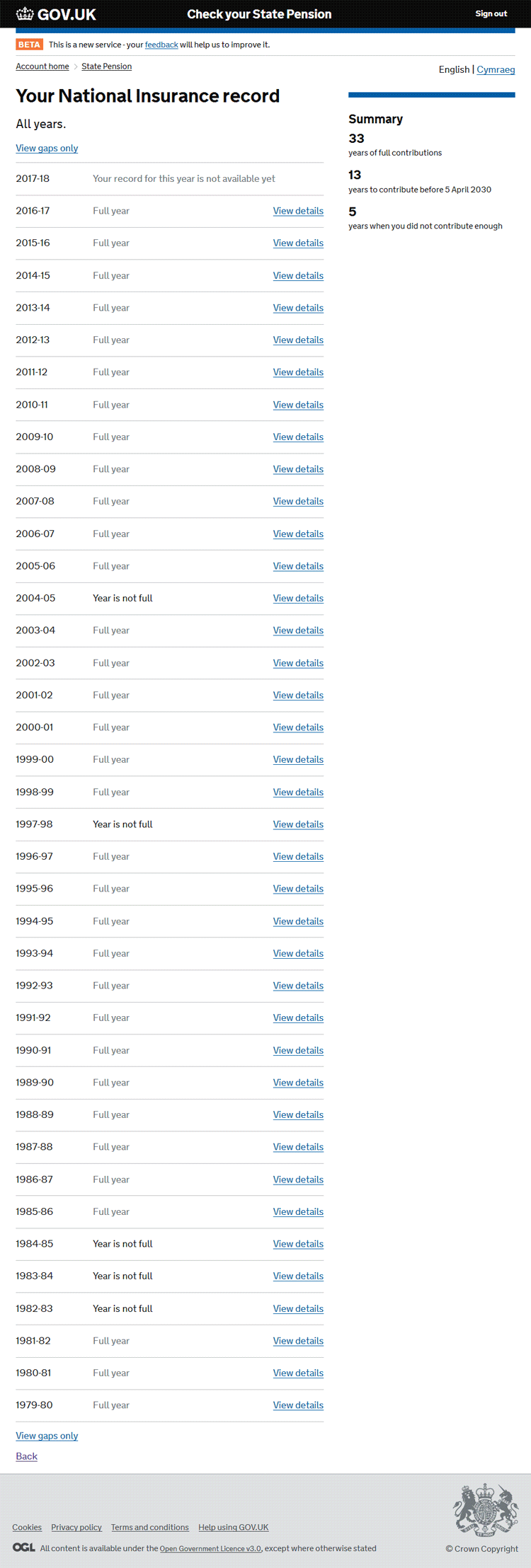
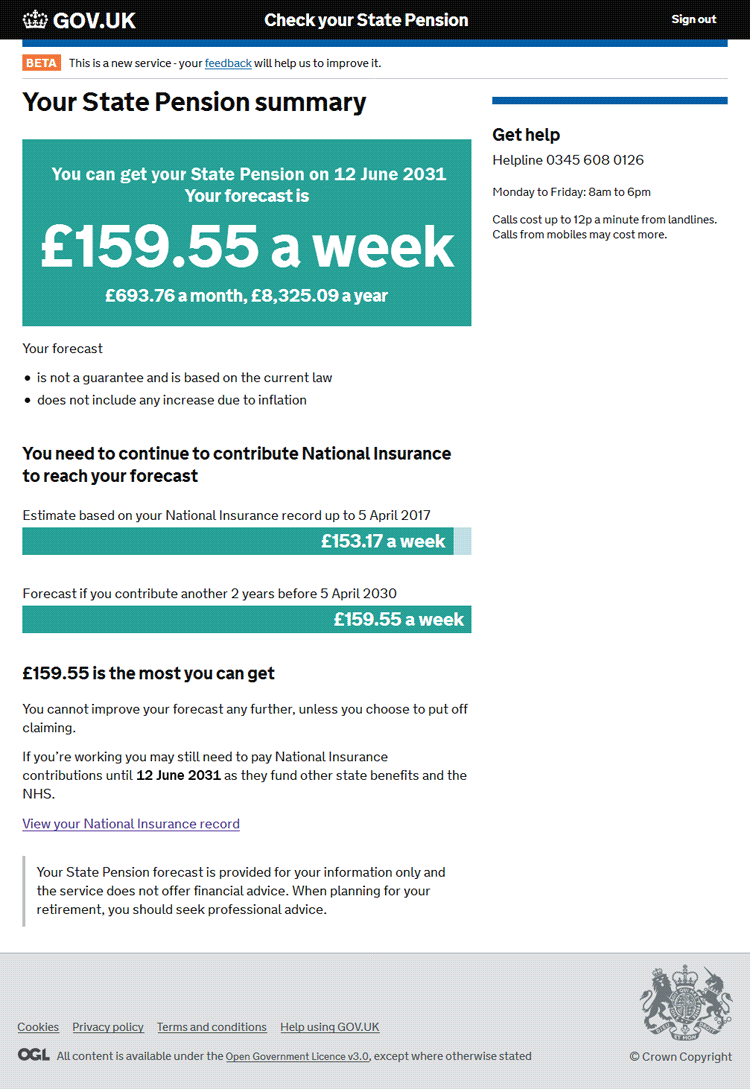
First, though, perhaps you’d like to sign up to view your PTA account for the first time. If you do this you can perhaps follow along with our notes and see how similar records in your PTA are to those in our demonstration account. For example, we found the National Insurance Record and resulting State Pension Forecast of particular interest, but that’s just indicative of many different areas available in the new PTAs. Before starting, though, take a look at our quick word about security* because it’s important to keep your personal details safe and out of harm’s way.
Anyway, if and when you’d like to take a look at your own PTA, head off to this page which will give you various options depending on whether you already have a Government Gateway account (to clarify, you will need a Government Gateway account before you can gain access to your PTA). If you’ve used HMRC online services before, you’ll already have a Government Gateway account. If not, follow the instructions on that page in order to set one up for the first time. To do that, you’ll need your National Insurance (NI) number and proof of identity which can include your bank account details, a P60, your 3 most recent payslips or your passport number and expiry date. It takes about 15 minutes to set up if you have these to hand.
When first logging in as a new user, the HMRC system may prompt you to set up an additional level of login security. For example, setting up access codes by SMS (you’ll then be sent a code to enter into the screen when logging in, to prove you are who you say you are. You’ll be sent a new access code to your mobile phone every time you sign in. It’s rather like 2FA (2 Factor Authentication) for those who are familiar with that).
You may additionally be asked some security questions, again to protect your data from hackers. In my test I was asked for my full name, date of birth, passport number and similar information (quite a bit actually). This type of heavy duty disclosure is another reason to make sure you have read our security* pointers before disclosing anything sensitive online.
Welcome to your Personal Tax Account (PTA)
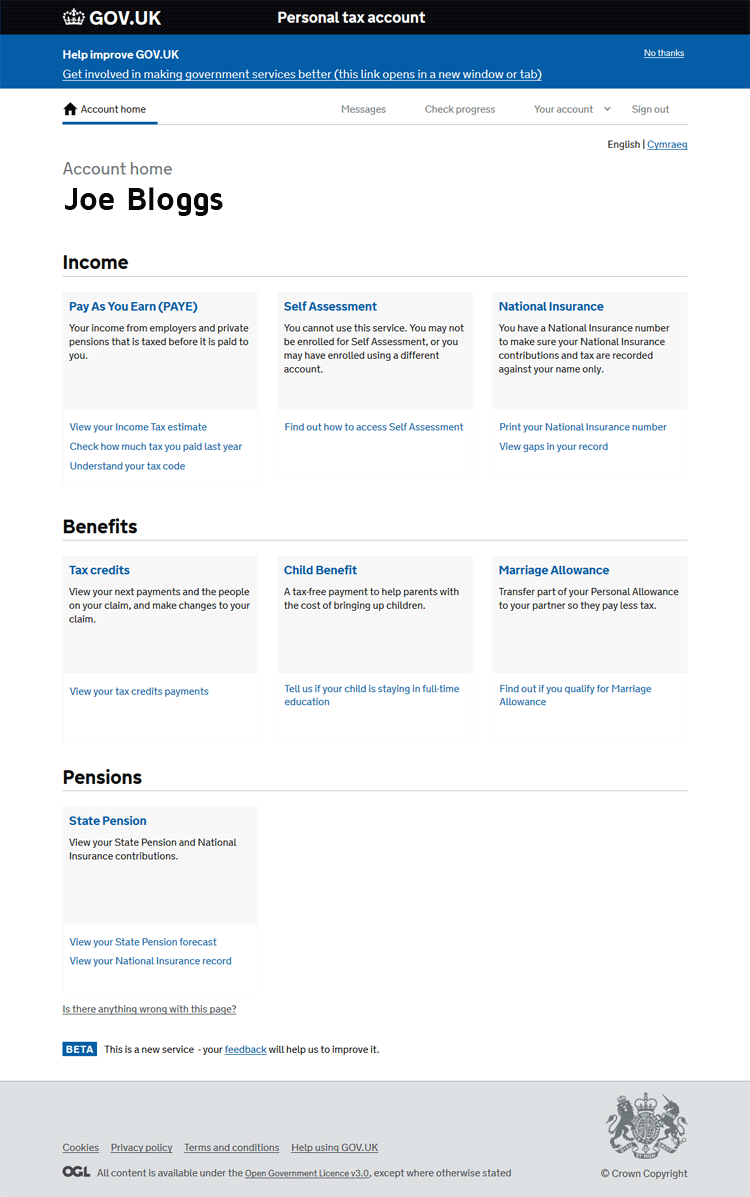
Once logged in you’ll be met with a screen similar to the image shown right, with your name at the top:
As you can see, it contains several sections. From your Personal Tax Account, you can:
Check your PAYE tax code, see an estimate of the Income Tax you’ll pay and more;
Check your Self Assessment details (or enrol) and view personal tax returns submitted in the past;
View your National Insurance record;
Check and amend your Tax Credits record;
Tell HMRC about any changes that might affect any Child Benefit you receive (e.g. tell HMRC if your child is staying in education or training if they were aged 16 on or before 31 August);
View and potentially update details about any Marriage Allowance if applicable to you (if you’re married or in a civil partnership and earn less than £11,500 you may be eligible);
View an entire history of your National Insurance (NI) contributions;
Check when you can claim your State Pension;
See a forecast of how much you may receive for your State Pension when the time comes.
https://www.taxfile.co.uk/wp-content/uploads/2017/10/Making-Tax-Digital-Header.jpg566849Markhttps://www.taxfile.co.uk/wp-content/uploads/2020/03/taxfile-logo-2020.pngMark2017-10-30 16:21:102021-10-31 19:48:54Making Tax Digital (‘MTD’), Part 1 — Your Personal Tax Account
We may request cookies to be set on your device. We use cookies to let us know when you visit our websites, how you interact with us, to enrich your user experience, and to customize your relationship with our website.
Click on the different category headings to find out more. You can also change some of your preferences. Note that blocking some types of cookies may impact your experience on our websites and the services we are able to offer.
Essential Website Cookies
These cookies are strictly necessary to provide you with services available through our website and to use some of its features.
Because these cookies are strictly necessary to deliver the website, refusing them will have impact how our site functions. You always can block or delete cookies by changing your browser settings and force blocking all cookies on this website. But this will always prompt you to accept/refuse cookies when revisiting our site.
We fully respect if you want to refuse cookies but to avoid asking you again and again kindly allow us to store a cookie for that. You are free to opt out any time or opt in for other cookies to get a better experience. If you refuse cookies we will remove all set cookies in our domain.
We provide you with a list of stored cookies on your computer in our domain so you can check what we stored. Due to security reasons we are not able to show or modify cookies from other domains. You can check these in your browser security settings.
Other external services
We also use different external services like Google Webfonts, Google Maps, and external Video providers. Since these providers may collect personal data like your IP address we allow you to block them here. Please be aware that this might heavily reduce the functionality and appearance of our site. Changes will take effect once you reload the page.